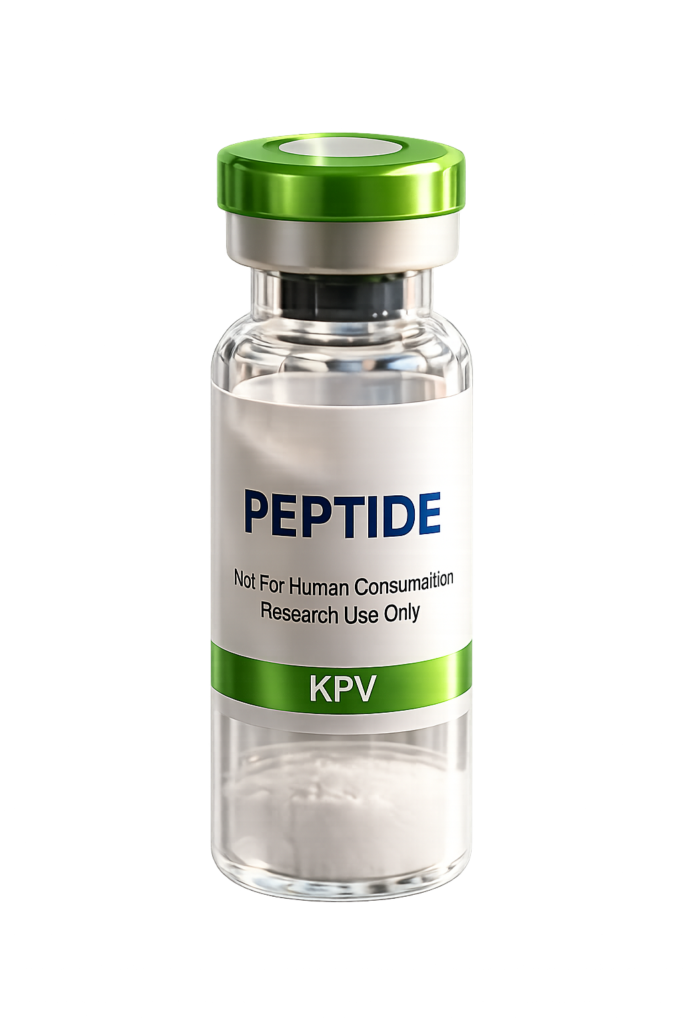
Protocols:
• Dose: 100-500 mcg once daily
• Cycle: 8-12 weeks
• Time off: 2-4 weeks
• Always filter after reconstitution
Protocols:
• Dose: 100-500 mcg once daily
• Cycle: 8-12 weeks
• Time off: 2-4 weeks
• Always filter after reconstitution
KPV Benefits
• Gastrointestinal Repair: KPV is heavily researched for its ability to reduce gut inflammation. It supports intestinal barrier integrity by promoting epithelial cell regeneration and reducing mucosal inflammation, making it a popular option for "leaky gut," IBS, and IBD (such as ulcerative colitis or Crohn's disease). [1, 2, 3, 4]
• Skin and Tissue Healing: Applied topically or systemically, KPV can accelerate wound healing and minimize scarring. Its anti-inflammatory and antimicrobial properties are often utilized to manage inflammatory skin conditions like eczema, psoriasis, acne, and rosacea. [1, 2, 3]
• Immune Modulation: Instead of shutting down the immune system, KPV helps regulate excessive immune responses. It acts as an "inflammation manager" that inhibits the NF-κB pathway—a master switch for inflammatory genes—which can provide relief for autoimmune flare-ups and histamine sensitivities (like MCAS). [1, 2, 3, 4]
• Antimicrobial Action: Preclinical research has demonstrated that KPV has natural antimicrobial effects, helping to fight off pathogens like Staphylococcus aureus and Candida albicans. [1]
• Systemic Inflammation: By suppressing pro-inflammatory cytokines (such as TNF-α and IL-6), KPV can lower the overall inflammatory burden in the body. [1, 2]
KPV Side Effects
Discussing KPV peptide side effects requires acknowledging a fundamental limitation: there are no completed human clinical trials with KPV. The safety profile is therefore extrapolated from animal studies, in vitro toxicity assessments, and the broader alpha-MSH safety literature.[1]
What can be reasonably stated:
• Animal model tolerability: in the murine colitis studies by Kannengiesser et al. (2008) and Dalmasso et al. (2008), KPV was administered systemically and orally without reported adverse effects at therapeutic doses. No weight loss, organ toxicity, or behavioural changes were noted.[3][4]
• Theoretical safety advantages: because KPV does not activate melanocortin receptors, it should not produce the pigmentation changes, nausea, facial flushing, or sexual arousal effects associated with melanocortin agonists like Melanotan 2 or PT-141.[1]• Immunosuppression considerations: any compound that suppresses NF-κB and inflammatory cytokines carries a theoretical risk of impairing immune defence when used systemically. This is a class concern shared with established anti-inflammatory therapies, not specific to KPV.
• Peptide stability and purity: as a tripeptide, KPV is relatively simple to synthesise, but research-grade peptides may contain impurities that would not be present in pharmaceutical-grade products. Purity considerations apply to any research peptide.
The absence of human safety data is the dominant feature of the KPV side effects discussion. Preclinical tolerability does not guarantee human safety, and the dose-response relationship in humans has not been characterised.
What is KPV?
KPV is the tripeptide sequence Lys-Pro-Val, corresponding to positions 11–13 of the alpha-MSH molecule. The name itself is simply the one-letter amino acid codes: K (lysine), P (proline), V (valine). This KPV tripeptide was first identified as a bioactive fragment when researchers studying alpha-MSH discovered that the anti-inflammatory properties of the full 13-amino-acid hormone could be preserved in much smaller fragments.[1][2]
The structural simplicity of KPV is part of its appeal in research. As a tripeptide, it is far smaller than alpha-MSH (which itself is only 1,665 Da), making synthesis straightforward and cost-effective. Unlike many larger peptides, the KPV peptide can be absorbed through epithelial barriers — a property that has driven particular interest in oral delivery for gastrointestinal applications.[4]
Alpha-MSH is produced in the pituitary gland, skin, gut, and immune cells, and signals primarily through melanocortin receptors (MC1R through MC5R). However, the KPV fragment does not appear to require melanocortin receptor binding for its anti-inflammatory effects — a critical distinction that separates it from compounds like Melanotan 2, which directly agonises melanocortin receptors to produce tanning and other effects.[1][7]
What does KPV actually do?
KPV is the tripeptide sequence Lys-Pro-Val, corresponding to positions 11–13 of the alpha-MSH molecule. The name itself is simply the one-letter amino acid codes: K (lysine), P (proline), V (valine). This KPV tripeptide was first identified as a bioactive fragment when researchers studying alpha-MSH discovered that the anti-inflammatory properties of the full 13-amino-acid hormone could be preserved in much smaller fragments.[1][2]
How KPV Works
The central mechanism identified in KPV research is inhibition of nuclear factor kappa-B (NF-κB), the master transcription factor controlling inflammatory gene expression. This KPV anti inflammatory action operates through a pathway that appears independent of classical melanocortin receptor signalling.[1][4]
Key mechanistic findings from the literature:
• NF-κB translocation inhibition: KPV prevents the nuclear translocation of NF-κB subunits (p65/p50) in multiple cell types, including colonocytes, keratinocytes, and macrophages. This blocks upstream activation of inflammatory gene transcription.[4][7]
• Pro-inflammatory cytokine suppression: downstream of NF-κB inhibition, KPV reduces production of TNF-α, IL-1β, and IL-6 — the core inflammatory cytokines driving tissue damage in conditions like colitis and dermatitis.[1][3]
• PepT1-mediated cellular uptake: a landmark finding from the Dalmasso (2008) study demonstrated that KPV enters intestinal epithelial cells via PepT1, the peptide transporter responsible for absorbing dietary di- and tripeptides. Once internalised, KPV directly interacts with intracellular inflammatory signalling pathways.[4]
• Melanocortin-independent activity: unlike full-length alpha-MSH, KPV does not appear to require MC1R or other melanocortin receptor engagement for its anti-inflammatory effects. This has been demonstrated in cells lacking melanocortin receptors, where KPV still reduces inflammatory markers.[1][7]
The PepT1 uptake pathway is particularly noteworthy. PepT1 is expressed along the entire intestinal epithelium and is upregulated during intestinal inflammation, meaning KPV uptake may actually increase in precisely the conditions where its anti-inflammatory effects are most relevant.[4] This mechanism is distinct from how peptides like BPC-157 are thought to interact with the gut, though both are studied in gastrointestinal inflammation contexts.
Half Life
Half-life: short, as expected for a tripeptide. Small peptides are rapidly cleared by peptidases in plasma and tissues. Precise half-life values for KPV in circulation have not been extensively characterised in published literature, but tripeptides generally have half-lives measured in minutes rather than hours.
References
1. Kosfeld M, et al. Oxytocin increases trust in humans. Nature. 2005;435(7042):673-676. PMID: 15931222
2. Guastella AJ, et al. Intranasal oxytocin improves emotion recognition for youth with autism spectrum disorders. Biol Psychiatry. 2010;67(7):692-694. PMID: 19897177
3. Kirsch P, et al. Oxytocin modulates neural circuitry for social cognition and fear in humans. J Neurosci. 2005;25(49):11489-11493. PMID: 16339042
4. Shamay-Tsoory SG, et al. Intranasal administration of oxytocin increases envy and schadenfreude (gloating). Biol Psychiatry. 2009;66(9):864-870. PMID: 19640508
5. Quintana DS, Woolley JD. Intranasal oxytocin mechanisms can be better understood, but its effects on social cognition and behavior are not to be sniffed at. Biol Psychiatry. 2016;79(8):e49-e50. PMID: 26212900
6. Yatawara CJ, et al. The effect of oxytocin nasal spray on social interaction deficits observed in young children with autism: a randomized clinical crossover trial. Mol Psychiatry. 2016;21(9):1225-1231. PMID: 26503762
7. MacDonald E, et al. A review of safety, side-effects and subjective reactions to intranasal oxytocin in human research. Psychoneuroendocrinology. 2011;36(8):1114-1126. PMID: 21429671
8. Leng G, Ludwig M. Intranasal oxytocin: myths and delusions. Biol Psychiatry. 2016;79(3):243-250. PMID: 26049207
9. Mekhael AA, et al. Evaluating the efficacy of oxytocin for pain management: an updated systematic review and meta-analysis of randomized clinical trials and observational studies. Reg Anesth Pain Med. 2023;48(10):477-486. PMID: 37205278
10. Kiani Z, et al. Oxytocin effect in adult patients with autism: an updated systematic review and meta-analysis of randomized controlled trials. Psychopharmacology (Berl). 2023;240(1):1-22. PMID: 35585805