
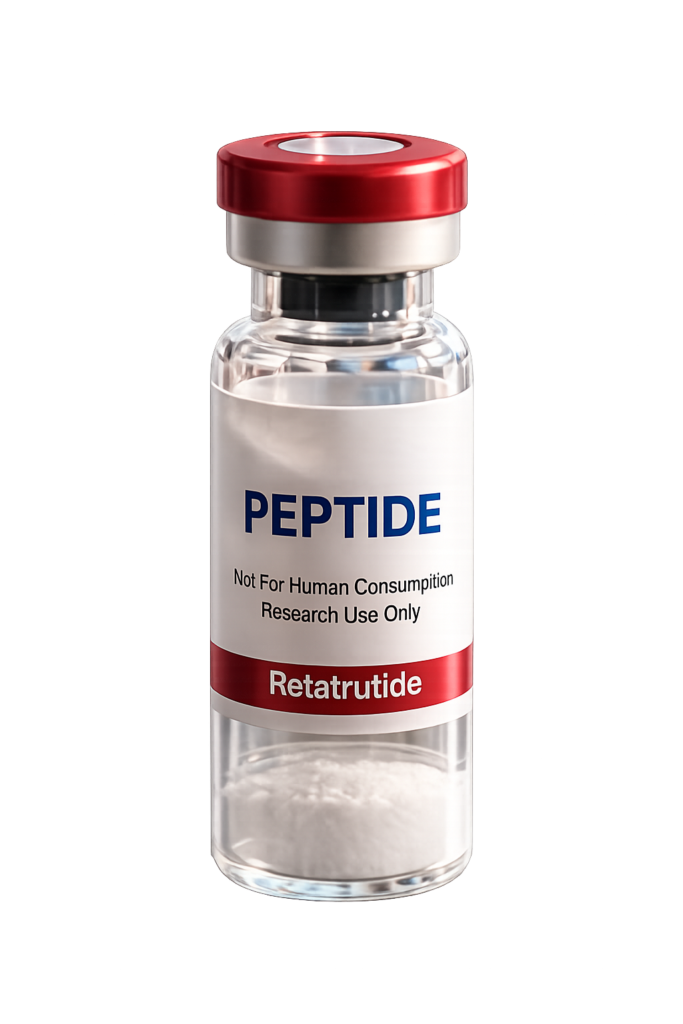
Protocols:
• Start: 0.5-1mg weekly
• Maintenance: Up to 12mg weekly(gradual build)
• Always filter after reconstitution
• See "Important Note" under Benefits section
Protocols:
• Start: 0.5-1mg weekly
• Maintenance: Up to 12mg weekly(gradual build)
• Always filter after reconstitution
• See "Important Note" under Benefits section
Retatrutide Benefits?
Retatrutide benefits based on available Phase 2 evidence:
• Unprecedented weight loss magnitude: up to 26-28% mean body weight reduction at 48 weeks — the largest for any anti-obesity medication in controlled trials, and still declining at study end.[1]
• Triple receptor mechanism: unique glucagon receptor component adds energy expenditure and fat oxidation pathways beyond appetite suppression, targeting fat mass through both intake reduction and output increase.[7][8]
• Extraordinary liver fat reduction: up to 82.4% liver fat clearance in the MASLD trial — the strongest hepatic fat reduction of any incretin-class compound.[3]
• Robust glycaemic improvement: HbA1c reductions of up to 2.0% in patients with type 2 diabetes.[2]
• Once-weekly dosing: consistent with other modern incretin agonists, supporting treatment adherence.[1][2]
• Multi-indication potential: Phase 3 TRIUMPH program spans obesity, T2D, OSA, and osteoarthritis — the broadest indication pipeline of any single incretin agonist.[6]
• Consistent efficacy across cohorts: weight loss and metabolic improvement demonstrated in both obesity and T2D populations, meta-analysis confirmed.[1][2][4]Important framing: all current retatrutide benefits data is from Phase 2 trials. While the results are exceptionally promising, FDA approval and full safety characterization require Phase 3 completion. The TRIUMPH program is expected to report results over the coming years.[6]
Important Note:
Retatrutide, like all GLP agonists, produces best results when accompanied with intermittent fasting (not intaking more than 5 calories total between 9pm and 2 pm the following day).
Benefits of Intermittent Fasting:
• Metabolic Switch: Your body shifts from using blood sugar to burning fat and ketones for fuel.
• Lower Insulin: Blood insulin levels drop significantly, which helps make body fat more accessible to burn.
• Cell Repair: Extended fasting triggers autophagy, a cellular cleanup process that removes damaged cells and waste.
• Weight Loss: Limits your daily eating window so you naturally eat fewer calories and lose body fat.
• Better Blood Sugar: Lowers fasting glucose and reduces insulin resistance, which helps manage pre-diabetes and type 2 diabetes.
• Heart Health: Helps lower blood pressure, resting heart rate, and cholesterol levels.
• Less Inflammation: Reduces chronic inflammation markers linked to aging and disease.
The above mentioned benefits to intermittent fasting are not achieved by merely eating smaller sized portions throughout the day.
Because GLPs make intermittent fasting so easy, it's a huge waste not to incorporate it into the GLP regiment.
Retatrutide Side Effects
For retatrutide side effects intent (search volume: 6,600), the safety profile is based on Phase 2 data with hundreds of participants, not yet the thousands typical of Phase 3:[1][2][11]
• Gastrointestinal effects (most common): nausea, diarrhoea, vomiting, and constipation — consistent with the GLP-1 receptor agonist class. In the NEJM Phase 2 trial, GI events were generally mild to moderate and most common during dose escalation. Incidence was dose-dependent.[1]
• Decreased appetite: reported frequently, though this is more of an intended pharmacological effect than a side effect per se.[1][2]
• Injection site reactions: generally mild.[1]
• Heart rate increase: small mean increases in heart rate observed, consistent with other GLP-1 agonists.[1][2]
• Glucagon-specific considerations: the glucagon receptor component theoretically increases hepatic glucose output, which could counteract the glucose-lowering effects in some contexts. In practice, the Phase 2 T2D trial showed net glycaemic improvement, suggesting the GLP-1/GIP components compensate effectively.[2][7]
What we don’t know yet:
• Long-term safety: the longest Phase 2 exposure is 48 weeks. Multi-year safety data will come from Phase 3 (TRIUMPH).[6]
• Cardiovascular outcomes: no dedicated CVOT has been completed for retatrutide. This will likely be required for full regulatory characterisation.
• Rare events: uncommon adverse events (pancreatitis, thyroid signals, gallbladder events) require larger Phase 3 populations to characterise properly.
• Glucagon receptor long-term effects: sustained glucagon receptor agonism is novel in this context. Any unexpected hepatic, metabolic, or body composition effects may only emerge with longer exposure.[8][9]The honest assessment: the Phase 2 safety profile appears manageable and broadly consistent with the GLP-1 agonist class, but the compound is genuinely novel (no triple agonist has been approved before), and caution is warranted until Phase 3 data is available.[1][4][11]
What is Retatrutide?
Retatrutide (or LY3437943) is a first-in-class triple hormone receptor agonist — a single molecule that activates GLP-1, GIP, and glucagon receptors simultaneously. It represents the most aggressive multi-receptor approach to obesity and metabolic disease currently in clinical development, and its Phase 2 trial results (published in the New England Journal of Medicine) produced the largest weight reductions ever reported for any anti-obesity medication.[1][2]
Retatrutide was developed by Eli Lilly (the same company behind tirzepatide). While tirzepatide is a dual GIP/GLP-1 agonist, retatrutide adds glucagon receptor activation as a third mechanism — introducing direct metabolic effects including increased energy expenditure, enhanced hepatic fat oxidation, and thermogenesis that go beyond appetite suppression alone.[2][7]
The compound is currently in Phase 3 clinical trials across multiple indications: obesity, type 2 diabetes, obstructive sleep apnea, and knee osteoarthritis. No GLP-1-class compound has entered Phase 3 with such strong weight loss signals from earlier-phase data.[1][6]
What does Retatrutide actually do?
Retatrutide produces weight loss and metabolic improvement through coordinated activation of three hormone receptors. The Phase 2 clinical results are unprecedented in the obesity pharmacotherapy field:[1][2]
• Weight loss (Phase 2, obesity): Jastreboff et al. (2023) demonstrated up to 24.2% mean body weight reduction at 48 weeks with retatrutide; 12 mg in adults with obesity — the largest weight loss ever reported for any anti-obesity medication in a controlled trial. Published in the New England Journal of Medicine.[1]
• Weight loss in T2D: Rosenstock et al. (2023) showed retatrutide produced up to 16.9% body weight loss in patients with type 2 diabetes, alongside HbA1c reductions of up to 2.0%. Published in The Lancet.[2]
• Liver fat reduction (MASLD): Sanyal et al. (2024) demonstrated that retatrutide reduced liver fat by up to 82.4% from baseline over 48 weeks, with 93% of participants achieving the ≥30% reduction threshold associated with MASLD resolution. Published in Nature Medicine.[3]
• Body composition: Coskun et al. (2025) published a body composition sub-study showing retatrutide produced substantial fat mass reduction. Published in Lancet Diabetes & Endocrinology.[5]
• Meta-analysis confirmation: Pasqualotto et al. (2024) conducted a systematic review and meta-analysis confirming retatrutide’s weight and metabolic benefits across available trials.[4]
How Retatrutide Works
Retatrutide’s triple agonist mechanism is what distinguishes it from all currently approved obesity treatments. Each receptor contributes distinct pharmacological effects:[7][8][9]
• GLP-1 receptor activation: reduces appetite through central hypothalamic and brainstem signalling, slows gastric emptying, and enhances glucose-dependent insulin secretion. This is the shared mechanism with semaglutide and liraglutide.[7][9]
• GIP receptor activation: potentiates the GLP-1-mediated appetite reduction and insulin secretion, while potentially improving fat tissue metabolism. This is the shared mechanism with tirzepatide (which is a dual GIP/GLP-1 agonist).[7][8]
• Glucagon receptor activation (unique to retatrutide): this is the critical differentiator. Glucagon receptor agonism increases hepatic fat oxidation, stimulates thermogenesis and energy expenditure, promotes amino acid catabolism, and reduces liver fat. Unlike GLP-1 and GIP (which primarily reduce caloric intake), glucagon receptor activation increases caloric output.[7][8][9]
The engineering insight: retatrutide doesn’t just suppress appetite more effectively — it adds an entirely new metabolic dimension. The glucagon component creates a “push-pull” effect: GLP-1 and GIP reduce energy intake, while glucagon increases energy expenditure. This dual mechanism likely explains the unprecedented weight loss results and the dramatic liver fat reductions seen in the MASLD trial.[1][3][7]
Half Life
Retatrutide has a plasma half-life of approximately 6 days, enabling once-weekly subcutaneous administration. This is comparable to other modern incretin agonists:[7]
Liraglutide: ~13 hours (daily injection)
Semaglutide: ~7 days (weekly injection)
Tirzepatide: ~5 days (weekly injection)
Retatrutide: ~6 days (weekly injection)
The ~6-day half-life provides sustained receptor activation across all three targets (GLP-1, GIP, glucagon) throughout the dosing interval, maintaining the coordinated metabolic effects between weekly injections.[7]
References
1. Jastreboff AM, et al. Triple-Hormone-Receptor Agonist Retatrutide for Obesity — A Phase 2 Trial. N Engl J Med. 2023;389(6):514-526. PMID: 37366315.
2. Rosenstock J, et al. Retatrutide, a GIP, GLP-1 and glucagon receptor agonist, for people with type 2 diabetes: a randomised, double-blind, placebo and active-controlled, parallel-group, phase 2 trial conducted in the USA. Lancet. 2023;402(10401):529-544. PMID: 37385280.
3. Sanyal AJ, et al. Triple hormone receptor agonist retatrutide for metabolic dysfunction-associated steatotic liver disease: a randomized phase 2a trial. Nat Med. 2024;30(8):2292-2300. PMID: 38858523.
4. Pasqualotto E, et al. Effects of once-weekly subcutaneous retatrutide on weight and metabolic markers: A systematic review and meta-analysis of randomized controlled trials. Metabol Open. 2024;24:100313. PMID: 39318607.
5. Coskun T, et al. Effects of retatrutide on body composition in people with type 2 diabetes: a substudy of a phase 2, double-blind, parallel-group, randomised controlled trial. Lancet Diabetes Endocrinol. 2025;13(7):527-537. PMID: 40609566.
6. Giblin K, et al. Retatrutide for the treatment of obesity, obstructive sleep apnea and knee osteoarthritis: Rationale and design of the TRIUMPH registration programme. Diabetes Obes Metab. 2026;28(2):e70089. PMID: 41090431.
7. Coskun T, et al. LY3437943, a novel triple glucagon, GIP, and GLP-1 receptor agonist for glycemic control and weight loss: From discovery to clinical proof of concept. Cell Metab. 2022;34(9):1234-1247.e9. PMID: 35985340.
8. Katsi V, et al. Retatrutide — A Game Changer in Obesity Pharmacotherapy. Biomolecules. 2025;15(7):935. PMID: 40563436.
9. Abdul-Rahman T, et al. The power of three: Retatrutide’s role in modern obesity and diabetes therapy. Eur J Pharmacol. 2024;984:177068. PMID: 39515565.
10. Abdrabou Abouelmagd A, et al. Efficacy and safety of retatrutide, a novel GLP-1, GIP, and glucagon receptor agonist for obesity treatment: a systematic review and meta-analysis. Proc (Bayl Univ Med Cent). 2025;38(3):361-368. PMID: 40291085.
11. Kaur M, et al. A review of an investigational drug retatrutide, a novel triple agonist agent for the treatment of obesity. Eur J Clin Pharmacol. 2024;80(5):621-632. PMID: 38367045.