
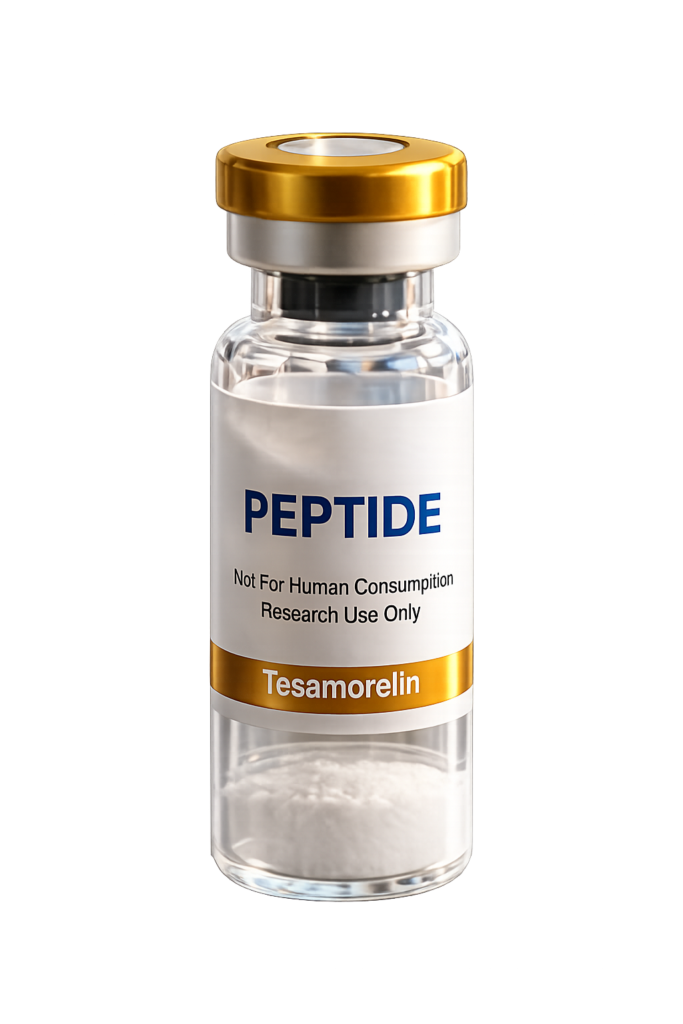
Protocols:
• Dose: 1-2 mg per day
• Cycle: 8-12 weeks
• Always filter after reconstitution
Protocols:
• Dose: 1-2 mg per day
• Cycle: 8-12 weeks
• Always filter after reconstitution
Tesamorelin Benefits
• Visceral fat reduction: the most robustly demonstrated benefit, confirmed across multiple RCTs and a 2026 meta-analysis. Clinically and statistically significant reductions in VAT, trunk fat, and waist circumference.[3][7]
• Body recomposition: concurrent lean mass increases alongside fat reduction, with improved muscle-to-fat ratios documented in multiple studies.[7][11]
• Metabolic marker improvements: reduced triglycerides, improved inflammatory markers, better adipose tissue quality.[8][9]
• Cognitive function improvement: early evidence for benefits in executive function and verbal memory in older adults.[5]
• Many men look to growth-hormone secretagogues, like Tesamorelin, when seeking "hormone optimization," though they do not raise testosterone. They are sometimes used to address overlapping symptoms like low energy, poor sleep, or slow recovery.
• NAFLD improvement: significant hepatic fat reduction and NAFLD resolution demonstrated in a Lancet HIV multi-centre RCT.[4]
• Preserved pulsatile GH secretion: augments natural GH pulsatility rather than replacing it, maintaining physiological regulation.[6]
• FDA-approved safety profile: tesamorelin is the only GHRH analog with an established regulatory safety and efficacy record.[1][2]The practical takeaway: tesamorelin has the strongest evidence base of any GHRH analog, with clinical trial quality that far exceeds the typical research peptide.
Benefits of tesamorelin are most clearly demonstrated for visceral fat reduction and liver health, with emerging signals for cognition and broader metabolic improvement.[7]
Tesamorelin Side Effects
For tesamorelin side effects intent, the safety profile benefits from extensive clinical trial data and FDA post-marketing surveillance:
• Injection site reactions: the most commonly reported adverse event across all trials — redness, swelling, itching, or pain at the injection site. Generally mild and self-limiting.[1][2]
• Arthralgia (joint pain): reported in clinical trials, likely related to GH/IGF-1 elevation. Usually mild to moderate.[2][7]
• Peripheral edema: fluid retention effects consistent with GH-axis stimulation. Typically transient and manageable.[2]
• Paraesthesia: tingling or numbness, particularly in extremities. A known GH-related effect.[2]
• Glucose metabolism effects: GH has known insulin-antagonistic properties. However, Clemmons et al. (2017) found tesamorelin did not significantly worsen glycemic control in type 2 diabetic patients.[12] Glucose monitoring remains appropriate.
• Hypersensitivity reactions: rare but documented in prescribing information. Contraindicated in patients with known hypersensitivity to tesamorelin or mannitol.[2]
The 2026 Badran meta-analysis confirmed that tesamorelin’s overall safety profile across pooled RCTs is acceptable, with adverse events predominantly mild and injection-site-related.[7]
The Russo et al. (2024) study in patients on integrase inhibitors further confirmed tolerability in contemporary antiretroviral therapy contexts.[13]
What is Tesamorelin?
Tesamorelin is a synthetic analog of growth hormone-releasing hormone (GHRH) that is the only GHRH-pathway peptide with FDA approval (marketed as Egrifta® and Egrifta SV®). It was approved specifically for reduction of excess abdominal fat in HIV-infected patients with lipodystrophy.[1][2]
What distinguishes tesamorelin peptide from other GH-axis compounds is the depth of its clinical evidence base. Unlike most research peptides discussed on this site, tesamorelin has been evaluated in multiple randomized, double-blind, placebo-controlled trials — including studies published in JAMA and The Lancet HIV.[3][4]
This clinical pedigree makes it the gold-standard reference point for the entire GHRH analog class.Tesamorelin works by stimulating the anterior pituitary to release growth hormone in a pulsatile pattern, which then drives hepatic IGF-1 production. The downstream effects include visceral fat reduction, improved body composition, favorable metabolic marker changes, and emerging evidence for hepatoprotective and cognitive benefits.[3][4][5]
For context across the GH-axis peptide class, this page pairs naturally with CJC-1295 (a longer-acting GHRH analog without FDA approval), Sermorelin (a shorter-acting GHRH analog), and Ipamorelin (a GH secretagogue that works via the ghrelin receptor rather than GHRH).
What does Tesamorelin actually do?
Tesamorelin stimulates the anterior pituitary to release growth hormone, which then drives IGF-1 production and downstream metabolic effects. Unlike exogenous GH administration, tesamorelin preserves pulsatile GH secretion patterns and maintains hypothalamic-pituitary feedback regulation.[1][6]
Key findings from clinical trials:
• Visceral fat reduction: the landmark Stanley et al. (2014) JAMA trial demonstrated significant reductions in both visceral adipose tissue and liver fat in HIV-infected patients with abdominal fat accumulation.[3]
• Liver fat reduction (NAFLD): Stanley et al. (2019) in The Lancet HIV showed tesamorelin significantly reduced hepatic fat fraction and prevented NAFLD progression, with improved liver fibrosis markers.[4]
• Body composition improvement: the 2026 Badran et al. meta-analysis pooling multiple RCTs confirmed significant reductions in visceral adipose tissue, trunk fat, and waist circumference, with concurrent improvements in lean body mass.[7]
• Metabolic improvements: improved triglyceride levels, reduced inflammatory markers, and favorable changes in adipose tissue quality documented across multiple trials.[8][9]
• Cognitive function: Baker et al. (2012) demonstrated that GHRH administration (using a tesamorelin analog protocol) improved cognitive function in both healthy older adults and adults with mild cognitive impairment — a finding that broadens the potential application beyond body composition.[5]
How Tesamorelin Works
Tesamorelin is a modified form of human GHRH(1-44)-NH₂ with a trans-3-hexenoic acid group attached to the tyrosine at position 1. This modification enhances stability and receptor binding while maintaining full biological activity at the GHRH receptor.[1][2]The mechanism operates through a well-characterised pathway:
• GHRH receptor activation: tesamorelin binds the GHRH receptor on somatotroph cells in the anterior pituitary, triggering GH synthesis and pulsatile release.[1][6]
• Pulsatile GH secretion: Stanley et al. (2011) specifically demonstrated that tesamorelin augments endogenous GH pulsatility — increasing both pulse amplitude and mean GH levels — while preserving the body’s natural secretory rhythm. This is pharmacologically important because pulsatile GH is more effective than continuous GH exposure for downstream metabolic effects.[6]
• IGF-1 cascade: elevated GH stimulates hepatic IGF-1 production, which mediates effects on body composition, tissue repair, and metabolic regulation.[3][7]
• Visceral adipose targeting: the preferential reduction in visceral (not subcutaneous) fat suggests pathway-specific lipolytic signalling, likely mediated through GH’s known effects on visceral adipocyte lipolysis and lipid oxidation.[3][8]
• Hepatoprotective effects: Fourman et al. (2020) used transcriptomic analysis to show that tesamorelin modulates hepatic gene expression in ways that reduce lipogenesis and inflammation, providing mechanistic insight into the NAFLD benefits.[10]
Half Life
Tesamorelin has a plasma half-life of approximately 26 minutes after subcutaneous injection. Despite this relatively short half-life, the downstream GH and IGF-1 effects persist substantially longer due to the cascade nature of the signaling pathway.[1][2]
For comparison within the GHRH analog class:
• Native GHRH: under 10 minutes (rapidly degraded by DPP-IV)
• Sermorelin: approximately 10-20 minutes
• Tesamorelin: approximately 26 minutes (trans-3-hexenoic acid modification provides moderate stability enhancement)
• CJC-1295 without DAC: approximately 30 minutes
• CJC-1295 with DAC: approximately 5-8 days (albumin binding)Practical takeaway: tesamorelin’s half-life is short, but the GH/IGF-1 response it triggers extends well beyond the peptide’s own plasma persistence. Clinical dosing is typically once daily, and the cumulative metabolic effects build over weeks to months of consistent use.[1][3]
References
1. Dhillon S. Tesamorelin: a review of its use in the management of HIV-associated lipodystrophy. Drugs. 2011;71(8):1071-1091. PMID: 21668043.
2. Falutz J. Tesamorelin: a novel therapeutic option for HIV/HAART-associated increased visceral adipose tissue. Drugs Today (Barc). 2011;47(10):751-761. PMID: 21695284.
3. Stanley TL, et al. Effect of tesamorelin on visceral fat and liver fat in HIV-infected patients with abdominal fat accumulation: a randomized clinical trial. JAMA. 2014;312(4):380-389. PMID: 25038357.
4. Stanley TL, et al. Effects of tesamorelin on non-alcoholic fatty liver disease in HIV: a randomised, double-blind, multicentre trial. Lancet HIV. 2019;6(12):e821-e830. PMID: 31611038.
5. Baker LD, et al. Effects of growth hormone-releasing hormone on cognitive function in adults with mild cognitive impairment and healthy older adults. Arch Neurol. 2012;69(11):1420-1429. PMID: 22869065.
6. Stanley TL, et al. Effects of a growth hormone-releasing hormone analog on endogenous GH pulsatility and insulin sensitivity in healthy men. J Clin Endocrinol Metab. 2011;96(1):150-158. PMID: 20943777.
7. Badran AS, et al. Body composition, hepatic fat, metabolic, and safety outcomes of Tesamorelin, a GHRH analogue, in HIV-associated lipodystrophy: a systematic review and meta-analysis. Obes Res Clin Pract. 2026;20(1):1-12. PMID: 41545261.
8. Fourman LT, et al. Visceral fat reduction with tesamorelin is associated with improved liver enzymes in HIV. AIDS. 2017;31(16):2253-2260. PMID: 28832410.
9. Lake JE, et al. Tesamorelin improves fat quality independent of changes in fat quantity. AIDS. 2021;35(6):967-972. PMID: 33756511.
10. Fourman LT, et al. Effects of tesamorelin on hepatic transcriptomic signatures in HIV-associated NAFLD. JCI Insight. 2020;5(16):e140134. PMID: 32701508.
11. Adrian S, et al. The Growth Hormone Releasing Hormone Analogue, Tesamorelin, Decreases Muscle Fat and Increases Muscle Area in Adults with HIV. J Frailty Aging. 2019;8(3):154-159. PMID: 31237318.
12. Clemmons DR, et al. Safety and metabolic effects of tesamorelin, a growth hormone-releasing factor analogue, in patients with type 2 diabetes: a randomized, placebo-controlled trial. PLoS One. 2017;12(6):e0179538. PMID: 28617838.
13. Russo SC, et al. Efficacy and safety of tesamorelin in people with HIV on integrase inhibitors. AIDS. 2024;38(11):1622-1629. PMID: 38905488.