
Protocols:
• Dose: 250-500 mcg per day
• Cycle: 4-8 weeks
• Time off: 2-4 weeks
• Always filter after reconstitution
Protocols:
• Dose: 250-500 mcg per day
• Cycle: 4-8 weeks
• Time off: 2-4 weeks
• Always filter after reconstitution
BPC-157 Benefits
• Accelerated soft-tissue recovery: consistent preclinical evidence for tendon, ligament, muscle, and gut healing support.[1][2][4][5]
• Improved training continuity: fewer forced rest days and less stop-start disruption in structured programmes.
• Better movement confidence: improved trust in repeatable movement quality under progressive load.
• Angiogenesis support: promotion of new blood vessel formation, which may support healing-environment quality at injury sites.[2][7]
• Gastroprotective properties: the “body protection compound” origin — preclinical evidence for gut mucosa protection and healing, including ulcer and fistula models.[1][10]
• Neuroprotective signals: emerging preclinical data on brain-gut axis interactions and CNS-related recovery contexts.[8][9]
What is BPC-157?
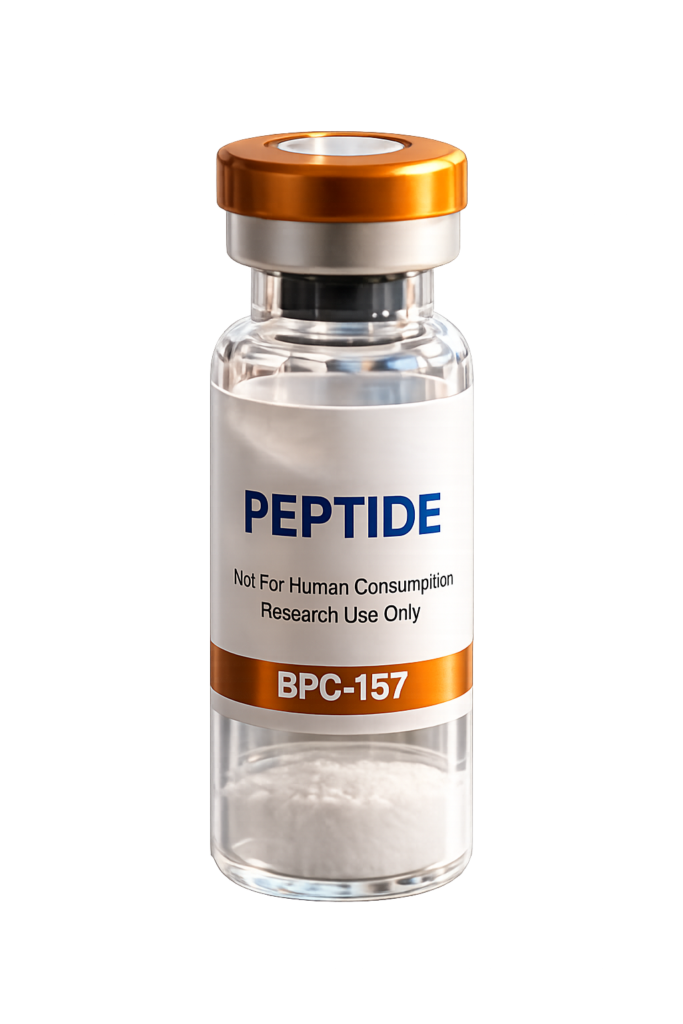
BPC-157 (Body Protection Compound-157) is a synthetic pentadecapeptide — a 15-amino-acid fragment derived from a protective protein found in human gastric juice — studied primarily in tissue-recovery, wound-healing, and musculoskeletal repair research contexts.[1][2][3]
It is sometimes referred to as the wolverine peptide due to its association with accelerated healing signals in preclinical models.In plain language, BPC-157 peptide (also written as BPC 157 peptide, bp 157 peptide, or bcp157) is usually interpreted as a recovery-continuity support candidate with strong preclinical evidence but limited human clinical data. Most interest centres on whether it can support more predictable recovery from soft-tissue stress — tendons, ligaments, muscles, and gut-related contexts.[1][4][5]
This page should be read alongside the TB-500 profile (the most common comparison peptide), the BPC-157 vs TB-500 side-by-side comparison, and the Injury & Tissue Support and Recovery & Sleep goal pages for broader context.
What does BPC-157 actually do?
BPC-157 is usually evaluated through a stability and recovery lens. The key question for BPC-157 benefits is whether irritation-to-function trends improve enough to reduce stop-start training or rehab cycles — not whether it produces overnight structural repair.
Useful practical markers include:
• Irritation-to-function trend: previously sensitive areas (tendons, joints, connective tissue) becoming more manageable under progressive load.
• Recovery smoothness: fewer hard rebound days after demanding sessions — the core of bpc 157 benefits in real-world interpretation.
• Routine adherence: improved ability to keep training or rehab frequency stable without forced rest days.
• Movement confidence: better trust in repeatable movement quality over multi-week blocks.Best interpreted as continuity support, not overnight transformation. The preclinical evidence base is substantial, but human clinical data remains early-stage.[3][5][6]
How BPC-157 Works
BPC-157 is commonly discussed in relation to multiple healing-related pathways: angiogenesis (new blood vessel formation), nitric oxide signalling, growth factor modulation (including VEGF, FGF, and EGF pathways), and tendon outgrowth promotion.[1][2][4][7]
The mechanistic picture from preclinical research suggests BPC-157 may create a more favorable healing environment by upregulating growth factor expression, promoting cell survival and migration at injury sites, and supporting collagen organisation in connective tissue.[4][7]
A 2025 systematic review in orthopaedic sports medicine confirmed consistent preclinical findings across tendon, ligament, muscle, and bone models — but emphasised the gap between animal model evidence and human clinical validation.[5]
In practice, signal interpretation is strongest when sleep, rehab structure, load progression, and nutrition are controlled. Without baseline control, confidence in attributing outcomes to any single compound drops quickly. Mechanistic plausibility does not equal guaranteed outcome in every real-world context.[3][6]
Half Life
For BPC-157 half-life (also searched as BPC 157 half life) queries: the pharmacokinetic profile of BPC-157 is not fully characterised in published human studies. Preclinical data suggests relatively rapid clearance, but public half-life claims vary widely by source and format — and certainty is often overstated in community discussion.
What is established: BPC-157 demonstrates notable stability in gastric juice (unusual for a peptide of this size), which is relevant to its origin as a gastric pentadecapeptide and to research exploring various administration approaches.[1][3]
Practical interpretation is usually stronger when tied to weekly recovery trends rather than exact timing assumptions. Use half-life as orientation only; use multi-week trend quality for decisions.
BPC-157 Side Effects
For both BPC-157 side effects and BPC 157 side effects intent, the evidence base is primarily preclinical, supplemented by limited human safety data. A 2025 pilot study on intravenous BPC-157 administration in humans reported no serious adverse events, but the sample size was small.[6]
Commonly discussed issues include:
• Nausea or GI discomfort: reported anecdotally, particularly at higher amounts or with certain administration approaches.
• Headache patterns: inconsistently reported, with unclear attribution given confounding variables.
• Administration-site irritation: localised discomfort reported in anecdotal contexts.
• High person-to-person variability: response profiles differ significantly between individuals, making generalisation difficult.
• Misattribution risk: when multiple recovery inputs change simultaneously (sleep, nutrition, training load, physio), side effect attribution to BPC-157 specifically becomes unreliable.The preclinical safety profile is generally favourable across a wide range of studies, with no reported organ toxicity or significant adverse effects in animal models.[1][3]
However, human evidence depth is still insufficient for definitive safety conclusions. Practical confidence should stay proportional to data quality.
References
1. Seiwerth S, et al. Stable Gastric Pentadecapeptide BPC 157 and Wound Healing. Front Pharmacol. 2021;12:627533. PMID: 34267654. PubMed.
2. Gwyer D, et al. Gastric pentadecapeptide body protection compound BPC 157 and its role in accelerating musculoskeletal soft tissue healing. Cell Tissue Res. 2019;377(2):153-159. PMID: 30915550. PubMed.
3. Józwiak M, et al. Multifunctionality and Possible Medical Application of the BPC 157 Peptide — Literature and Patent Review. Pharmaceuticals (Basel). 2025;18(2):185. PMID: 40005999. PubMed.
4. Krivic A, et al. BPC 157 and Standard Angiogenic Growth Factors. Gastrointestinal Tract Healing, Lessons from Tendon, Ligament, Muscle and Bone Healing. Curr Pharm Des. 2018;24(18):1972-1989. PMID: 29998800. PubMed.
5. Vasireddi N, et al. Emerging Use of BPC-157 in Orthopaedic Sports Medicine: A Systematic Review. HSS J. 2025. PMID: 40756949. PubMed.
6. Safety of Intravenous Infusion of BPC157 in Humans: A Pilot Study. Altern Ther Health Med. 2025. PMID: 40131143. PubMed.
7. Staresinic M, et al. The promoting effect of pentadecapeptide BPC 157 on tendon healing involves tendon outgrowth, cell survival, and cell migration. J Appl Physiol. 2011;110(3):811-820. PMID: 21030672. PubMed.
8. Sikiric P, et al. Brain-gut Axis and Pentadecapeptide BPC 157: Theoretical and Practical Implications. Curr Neuropharmacol. 2016;14(8):857-865. PMID: 27138887. PubMed.
9. Sikiric P, et al. Stable Gastric Pentadecapeptide BPC 157 May Recover Brain-Gut Axis and Gut-Brain Axis Function. Pharmaceuticals (Basel). 2023;16(5):676. PMID: 37242459. PubMed.
10. Sikiric P, et al. Stable Gastric Pentadecapeptide BPC 157 and Striated, Smooth, and Heart Muscle. Biomedicines. 2022;10(12):3338. PMID: 36551977. PubMed.