
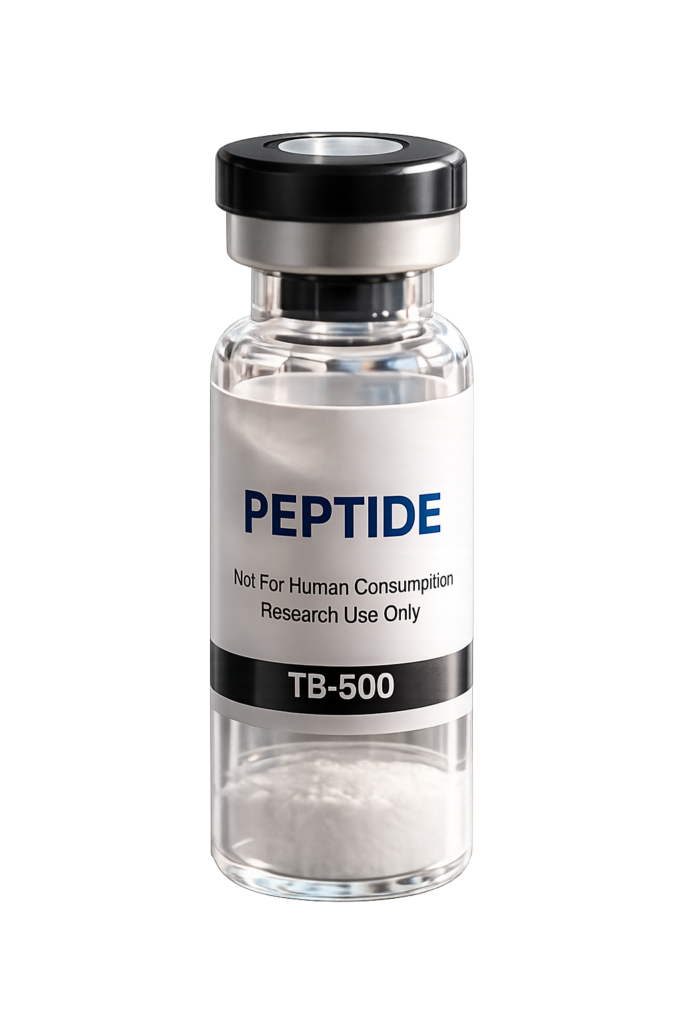
Protocols:
• Dose: 2-5 mg, 2x weekly
• Cycle: 4-6 weeks
• Time off: 2-4 weeks
• Always filter after reconstitution
Protocols:
• Dose: 2-5 mg, 2x weekly
• Cycle: 4-6 weeks
• Time off: 2-4 weeks
• Always filter after reconstitution
TB-500 Benefits
TB-500 benefits are strongest when interpreted through evidence-weighted framing:
• Wound healing acceleration: consistent across dermal, corneal, and cardiac wound models in animals. The most replicated finding in the TB-500 literature.[3][5][6]
• Anti-inflammatory activity: downregulation of pro-inflammatory cytokines and NF-κB signalling, creating more favourable repair conditions.[2][8]
• Hair follicle activation: stem cell migration and differentiation in mouse hair growth models. Consistent preclinical signals across multiple studies.[9][10]
• Corneal repair: accelerated epithelial healing and reduced inflammation in corneal injury models, with clinical ophthalmology interest.[5][6]
• Cardiac function improvement: reduced scar size and improved ventricular function in ischaemic models, with first-in-human STEMI data published 2025.[4][7][8]
• Training continuity support: in the practical context, TB-500 is often evaluated by fewer stop-start disruptions, better movement confidence, and more consistent recovery rhythm across training blocks.Evidence-weighted read: animal tissue-repair data is extensive and consistent. Human cardiac data is emerging. Other human clinical data remains limited. Support-pattern outcomes are plausible, but certainty remains context-dependent.[2][4]
TB-500 Side Effects
For tb-500 side effects intent, the safety profile draws primarily from animal studies and the limited human cardiac data:
• Headache patterns: reported in anecdotal contexts. Not systematically documented in controlled research.
• Nausea or GI discomfort: occasional reports in practical use contexts.
• Injection site reactions: redness, swelling, or discomfort at injection sites. Consistent with most subcutaneous peptide administration.
• Lethargy or fatigue: transient tiredness reported by some users, typically resolving within days.
• Substantial person-to-person variability: individual responses vary considerably, and attribution is difficult when multiple recovery variables change simultaneously.The 2025 human cardiac study reported thymosin beta-4 was well tolerated in STEMI patients, though this was a specific clinical population receiving specific protocols.[4]
Broader human safety profiling for TB-500 at various research concentrations remains limited. Trend-based interpretation over weeks is more reliable than single-day reactions.[2]
What is TB-500?
TB-500 is a synthetic peptide fragment corresponding to the active region (amino acids 17-23) of thymosin beta-4, a naturally occurring 43-amino-acid protein involved in cell migration, wound healing, and tissue repair signalling.[1][2]
In plain language, tb-500 peptide (also written as tb 500 or tb500) is studied primarily through a recovery and tissue-repair lens. Thymosin beta-4 is one of the most abundant intracellular proteins in mammalian cells, where it plays a central role in actin polymerisation, cell motility, and tissue remodelling. TB-500 replicates the region of thymosin beta-4 responsible for its actin-binding and cell-migration properties.[1][3]
The research profile spans wound healing, cardiac repair, corneal injury, hair follicle activation, and anti-inflammatory activity. Animal data is extensive and directionally consistent. Human clinical data is limited but emerging, with a 2025 cardiac study providing the first controlled human evidence.[4] For adjacent context, this page pairs naturally with BPC-157 and the BPC-157 vs TB-500 comparison.
What does TB-500 actually do?
TB-500 is usually evaluated through a recovery-continuity lens. The core action centres on actin regulation: TB-500 sequesters G-actin monomers, promoting the formation of new actin filaments that drive cell migration to injury sites. This is the mechanistic foundation for its tissue-repair signals across multiple organ systems.[1][3]
Useful practical markers from the literature include:
• Wound closure acceleration: faster epithelialisation and granulation tissue formation in dermal, corneal, and cardiac wound models.[3][5][6]
• Cardiac tissue repair: improved ventricular function and reduced scar size in ischaemic heart models, with the first human cardiac data published in 2025.[4][7]
• Anti-inflammatory activity: downregulation of pro-inflammatory cytokines and modulation of inflammatory cell infiltration at injury sites.[2][8]
• Hair follicle activation: thymosin beta-4 stimulates hair growth via stem cell migration and differentiation in mouse models.[9][10]
• Corneal wound healing: accelerated corneal epithelial repair and reduced inflammation following chemical injury, with human clinical interest in ophthalmology.[5][6]
Best framed as support-context for recovery rhythm across tissue types, not a guaranteed structural repair tool. The breadth of tissue responses is notable but the depth of human evidence remains limited.
How TB-500 Works
TB-500 is a synthetic fragment of thymosin beta-4, replicating the 17-23 amino acid sequence (LKKTETQ) that mediates its biological activity. The parent protein thymosin beta-4 is one of the most studied members of the beta-thymosin family and plays fundamental roles in cellular architecture and tissue repair.[1][2]
Key mechanisms identified in the literature:
• Actin polymerisation regulation: TB-500 sequesters G-actin monomers, controlling the balance between monomeric and filamentous actin. This drives cell migration, a prerequisite for wound healing and tissue remodelling in every tissue type studied.[1][3]
• Cell migration promotion: by modulating the actin cytoskeleton, TB-500 promotes directional migration of endothelial cells, keratinocytes, and cardiac progenitor cells toward injury sites.[3][4]
• Angiogenesis: stimulates new blood vessel formation via endothelial cell migration and VEGF-related pathways, supporting nutrient and oxygen delivery to healing tissues.[3][7]
• Anti-inflammatory signalling: downregulates NF-κB-mediated inflammatory responses and reduces pro-inflammatory cytokine production, creating a more favourable environment for tissue repair.[2][8]
• Stem cell activation: in hair follicle models, thymosin beta-4 activates follicular stem cells and promotes their migration and differentiation.[9][10]
The interpretation point that matters: mechanism plausibility does not equal guaranteed outcome. TB-500 has strong mechanistic logic and consistent animal data, but signal quality in any individual context still depends on injury type, timing, and the broader recovery environment.
Half Life
For tb-500 half-life queries: TB-500 is commonly discussed with a multi-day persistence context, often cited around 2 to 3 days in practical discussions. The equine pharmacokinetic analysis by Ho et al. (2012) characterised TB-500 detection windows in plasma and urine, providing the most detailed pharmacokinetic data available for this peptide.[12]
Exact human pharmacokinetic certainty is still limited. The peptide’s relatively long half-life compared to smaller peptides like GHK-Cu (which degrades in minutes to hours) is attributed to its larger size (4963 g/mol) and protein-like structure.
Practical takeaway: use half-life as orientation, then judge outcomes by weekly recovery and movement-trend quality rather than strict clock assumptions.
References
1. Philp D, et al. Thymosin beta4 promotes angiogenesis, wound healing, and hair follicle development. Mech Ageing Dev. 2004;125(2):113-115. PMID: 15037013.
2. Mayfield CK, et al. Injectable Peptide Therapy: A Primer for Orthopaedic and Sports Medicine Physicians. Am J Sports Med. 2026;54(1):223-229. PMID: 41476424.
3. Philp D. Animal studies with thymosin beta, a multifunctional tissue repair and regeneration peptide. Ann N Y Acad Sci. 2010;1194:81-86. PMID: 20536453.
4. Zhang Y, et al. Recombinant human thymosin beta 4 improves ischemic cardiac dysfunction in mice and patients with acute ST-segment elevation myocardial infarction. Cardiovasc Res. 2025;121(4):cvaf024. PMID: 41229390.
5. Sosne G, et al. Thymosin beta 4 promotes corneal wound healing and decreases inflammation in vivo following alkali injury. Exp Eye Res. 2002;74(2):293-299. PMID: 11950239.
6. Sosne G. Thymosin beta 4 and the eye: the journey from bench to bedside. Expert Opin Biol Ther. 2018;18(sup1):99-104. PMID: 30063853.
7. Smart N, et al. Thymosin beta-4 is essential for coronary vessel development and promotes neovascularization via adult epicardial progenitors. Ann N Y Acad Sci. 2007;1112:171-188. PMID: 17495252.
8. Maar K, et al. Thymosin Beta-4 Modulates Cardiac Remodeling by Regulating ROCK1 Expression in Adult Mammals. Int J Mol Sci. 2025;26(8):3476. PMID: 40362372.
9. Gao X, et al. Thymosin Beta-4 Induces Mouse Hair Growth. PLoS One. 2015;10(6):e0130040. PMID: 26083021.
10. Philp D, et al. Thymosin beta4 increases hair growth by activation of hair follicle stem cells. FASEB J. 2004;18(2):385-387. PMID: 14657002.
11. Rahman OF, et al. Therapeutic Peptides in Orthopaedics: Applications, Challenges, and Future Directions. JAAOS Glob Res Rev. 2026;10(1):e24.00304. PMID: 41490200.
12. Ho ENM, et al. Doping control analysis of TB-500, a synthetic version of an active region of thymosin beta-4, in equine urine and plasma by liquid chromatography-mass spectrometry. J Chromatogr A. 2012;1265:1-9. PMID: 23084823.
13. Ou H, et al. Thymosin beta-4-derived peptides alleviate neuroinflammation and neurite atrophy in both in vitro models and in vivo. Int Immunopharmacol. 2026;148:114091. PMID: 41443105.