
Protocols:
• Dose: 100-200 mcg, 1-3x daily
• Cycle: 8-12 weeks
• Time off: 4-6 weeks
• Always filter after reconstitution
Protocols:
• Dose: 100-200 mcg, 1-3x daily
• Cycle: 8-12 weeks
• Time off: 4-6 weeks
• Always filter after reconstitution
CJC-1295 Benefits
CJC-1295 benefits are best understood through the evidence hierarchy:
• Recovery support: improved recovery quality and training continuity reported in practical contexts, mediated through GH/IGF-1-dependent tissue repair pathways.[5][10]
• Body composition support: indirect support for lean mass maintenance and fat reduction through improved GH axis signalling, with GHRH-analog class evidence from tesamorelin trials providing directional support.[8]
• Aging-related GH decline mitigation: the somatopause literature supports GHRH analog use as a more physiological approach to age-related GH decline than exogenous GH.[6][7][9]
• Many men look to growth-hormone secretagogues like CJC-1295 when seeking "hormone optimization," though they do not raise testosterone. They are sometimes used to address overlapping symptoms like low energy, poor sleep, or slow recovery.
• Sustained GH/IGF-1 elevation: the most directly demonstrated benefit, with 2- to 10-fold GH increases and 1.5- to 3-fold IGF-1 increases documented in human subjects.[1]
• Preserved pulsatile secretion: unlike exogenous GH, CJC-1295 maintains natural GH pulse patterns, which is pharmacologically significant for downstream signalling quality.[2]
• Extended duration of action: the DAC version provides days of sustained activity from a single injection, reducing administration frequency compared to shorter-acting GHRH analogs.[1][4]
Evidence-weighted read: GH/IGF-1 elevation is well-documented in humans. Downstream clinical outcomes (body composition, recovery, aging) are supported by mechanism and class-level evidence but lack large-scale CJC-1295-specific outcome trials. Benefits of CJC-1295 are strongest when fundamentals are stable and outcomes are judged by trend quality over weeks.[1][5]
What is CJC-1295?
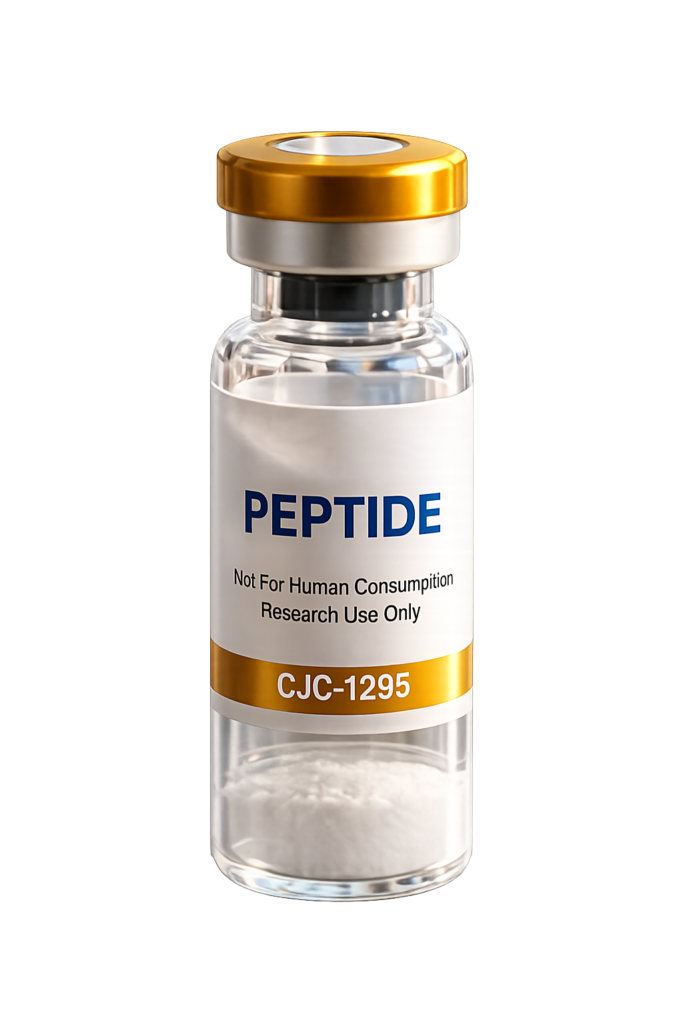
CJC-1295 is a synthetic analog of growth hormone-releasing hormone (GHRH) that stimulates pulsatile growth hormone (GH) secretion from the anterior pituitary. It is one of the most widely discussed CJC-1295 peptide compounds in GH-axis research contexts.[1][2]
In the landmark human study, Teichman et al. (2006) demonstrated that a single dose of CJC-1295 produced sustained 2- to 10-fold increases in GH concentration and 1.5- to 3-fold increases in IGF-1 levels, with effects persisting for up to 6 days after injection. After multiple doses, mean IGF-1 levels increased by 1.5- to 3-fold for 9 to 11 days.[1]
This prolonged duration distinguishes CJC-1295 from shorter-acting GHRH analogs like Sermorelin.Importantly, Ionescu & Bhatt (2006) confirmed that pulsatile GH secretion is preserved during continuous CJC-1295 stimulation, meaning the compound works within the body’s natural secretory rhythm rather than overriding it.[2]
This pulsatility preservation is a key pharmacological advantage over exogenous GH administration.For context across the GH-axis peptide class, this page pairs naturally with Ipamorelin (a GH secretagogue that works via the ghrelin receptor rather than GHRH), Sermorelin (a shorter-acting GHRH analog), and Tesamorelin (a GHRH analog with FDA approval for HIV-associated lipodystrophy).
What does CJC-1295 actually do?
CJC-1295 peptide stimulates the anterior pituitary to release growth hormone in a pulsatile pattern that mirrors natural GH secretion. The practical effect is an elevated GH/IGF-1 baseline over days rather than hours, which is why CJC-1295 is typically evaluated by multi-week trend quality rather than acute single-dose response.[1][2]
Key findings from human and preclinical data:
• Sustained GH elevation: 2- to 10-fold increases in GH concentration persisting for up to 6 days after a single injection in healthy adults.[1]
• IGF-1 amplification: 1.5- to 3-fold increases in IGF-1 levels sustained for 9 to 11 days after multiple doses, indicating cumulative signalling.[1]
• Pulsatility preservation: unlike exogenous GH, CJC-1295 maintains the body’s natural pulsatile GH secretion pattern, which is considered physiologically important for downstream signalling quality.[2]
• Serum protein profile changes: Sackmann-Sala et al. (2009) documented measurable changes in serum protein profiles in healthy subjects following CJC-1295 administration, suggesting broader systemic effects beyond isolated GH elevation.[3]
• GRF receptor activation: the parent sequence GRF(1-29) activates the GHRH receptor on the anterior pituitary with high specificity, and CJC-1295’s modifications extend this activation window.[4]
The practical interpretation framework: CJC-1295 creates a more favourable GH signalling environment over time. Whether that translates into measurable recovery, body composition, or sleep benefits depends on baseline conditions, training structure, and how consistently fundamentals are controlled.
How CJC-1295 Works
CJC-1295 is a modified version of the first 29 amino acids of growth hormone-releasing hormone (GHRH, also called GRF 1-29). The modifications serve two purposes: protecting the peptide from enzymatic degradation (DPP-IV cleavage) and, in the DAC version, enabling covalent binding to serum albumin for extended half-life.[1][4]
The mechanism operates through a well-characterised pathway:
• GHRH receptor binding: CJC-1295 binds the GHRH receptor on somatotroph cells in the anterior pituitary, triggering intracellular cAMP signalling that stimulates GH synthesis and release.[4][5]
• Pulsatile release preservation: the hypothalamic-pituitary feedback loop remains intact during CJC-1295 stimulation, meaning GH is released in pulses rather than continuous elevation. This is pharmacologically significant because pulsatile GH is more effective at driving IGF-1 production and downstream tissue effects than continuous GH exposure.[2]
• IGF-1 cascade: elevated GH stimulates hepatic IGF-1 production, which mediates many of the anabolic, recovery, and body composition effects attributed to the GH axis.[1][3]
• Somatostatin sensitivity retained: CJC-1295 does not override somatostatin (the GH-inhibiting hormone), meaning the body’s natural braking system remains functional. This contrasts with approaches that bypass pituitary regulation entirely.[2][5]
The engineering distinction matters: CJC-1295’s longevity comes from modified amino acids (to resist DPP-IV degradation) and, in the DAC formulation, a Drug Affinity Complex that binds albumin. This extends the effective half-life from minutes (native GHRH) to days.[1][4]
Half Life
For CJC-1295 half-life queries: the half-life varies significantly depending on DAC status.CJC-1295 with DAC: approximately 5 to 8 days, owing to covalent albumin binding via the Drug Affinity Complex. This is the version used in the Teichman et al. study, which showed GH effects persisting for up to 6 days after a single dose.[1][4]
CJC-1295 without DAC (Mod GRF 1-29): approximately 30 minutes. The DPP-IV-resistant amino acid modifications extend the half-life beyond native GHRH (which degrades in under 10 minutes) but without albumin binding, clearance remains relatively rapid.For comparison: native GHRH has a half-life under 10 minutes. Sermorelin (GRF 1-29 without modifications) has a similarly short half-life. CJC-1295 with DAC represents a roughly 500-fold increase in persistence over native GHRH.[1][4]
Practical takeaway: use half-life as orientation for administration frequency planning, but judge outcomes by weekly recovery and output trends rather than strict pharmacokinetic clock assumptions.
CJC-1295 Side Effects
For CJC-1295 side effects intent, the safety profile draws from the Teichman human study and broader GH secretagogue class data:
• Injection site reactions: redness, swelling, or irritation at injection sites. The most commonly reported adverse effect in the Teichman study.[1]
• Water retention: transient fluid retention and puffiness, consistent with elevated GH/IGF-1 activity. Usually resolves with hydration management.
• Headache: reported in some subjects during clinical evaluation.[1]
• Flushing or warmth: transient post-injection flushing reported in some users.
• Appetite changes: GH axis stimulation can influence appetite patterns, though direction and magnitude vary considerably between individuals.
• Glucose handling concerns: GH has known insulin-antagonistic effects. Sigalos & Pastuszak (2018) noted that glucose metabolism monitoring is appropriate with GH secretagogue use, particularly in metabolically sensitive populations.[5]
• Person-to-person variability: individual responses vary substantially. Attribution is difficult when multiple variables (training, nutrition, sleep) change simultaneously.The Teichman study reported CJC-1295 was generally well tolerated, with adverse events mostly mild and injection-site-related.[1]
Sigalos & Pastuszak’s 2018 review concluded that GH secretagogues as a class have acceptable safety profiles, while noting the need for longer-term surveillance.[5] Weekly trend logging is more reliable than single-day reactions when assessing side effect significance.
References
1. Teichman SL, et al. Prolonged stimulation of growth hormone (GH) and insulin-like growth factor I secretion by CJC-1295, a long-acting analog of GH-releasing hormone, in healthy adults. J Clin Endocrinol Metab. 2006;91(3):799-805. PMID: 16352683.
2. Ionescu M, Bhatt DL. Pulsatile secretion of growth hormone (GH) persists during continuous stimulation by CJC-1295, a long-acting GH-releasing hormone analog. J Clin Endocrinol Metab. 2006;91(12):4792-4797. PMID: 17018654.
3. Sackmann-Sala L, et al. Activation of the GH/IGF-1 axis by CJC-1295, a long-acting GHRH analog, results in serum protein profile changes in normal adult subjects. Growth Horm IGF Res. 2009;19(6):471-477. PMID: 19386527.
4. Jetté L, et al. Human growth hormone-releasing factor (hGRF)1-29-albumin bioconjugates activate the GRF receptor on the anterior pituitary in rats: identification of CJC-1295 as a long-lasting GRF analog. Endocrinology. 2005;146(7):3052-3058. PMID: 15817669.
5. Sigalos JT, Pastuszak AW. The Safety and Efficacy of Growth Hormone Secretagogues. Sex Med Rev. 2018;6(1):45-53. PMID: 28400207.
6 Sattler FR. Growth hormone in the aging male. Best Pract Res Clin Endocrinol Metab. 2013;27(4):541-555. PMID: 24054930.
7. Merriam GR, et al. Growth hormone-releasing hormone and growth hormone secretagogues in normal aging. Endocrine. 2003;22(1):41-48. PMID: 14610297.
8. Badran AS, et al. Body composition, hepatic fat, metabolic, and safety outcomes of Tesamorelin, a GHRH analogue, in HIV-associated lipodystrophy: a systematic review and meta-analysis. Obes Res Clin Pract. 2026;20(1):1-12. PMID: 41545261.
9. Merriam GR. Potential applications of GH secretagogs in the evaluation and treatment of the age-related decline in growth hormone secretion. Endocrine. 1997;7(1):49-52. PMID: 9449031.
10. Mayfield CK, et al. Injectable Peptide Therapy: A Primer for Orthopaedic and Sports Medicine Physicians. Am J Sports Med. 2026;54(1):223-229. PMID: 41476424.