
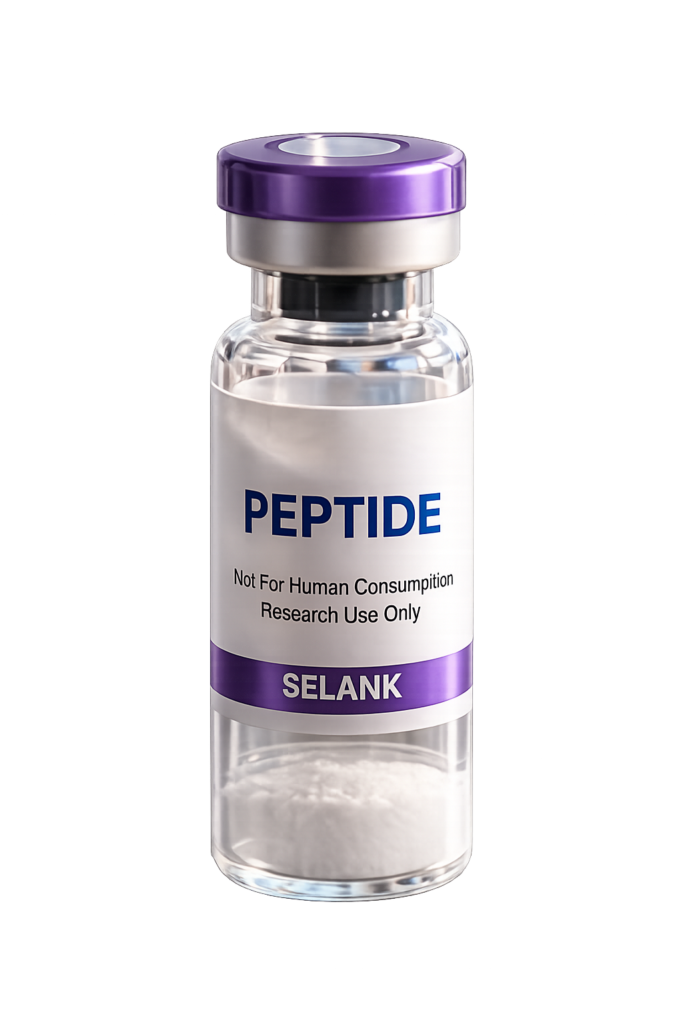
Protocols:
• Dose: 300–550 mcg daily
• Cycle: 3-4 weeks
• Time off: 4 weeks
• Always filter after reconstitution
Protocols:
• Dose: 300–550 mcg daily
• Cycle: 3-4 weeks
• Time off: 4 weeks
• Always filter after reconstitution
SELANK Benefits
The Selank benefits profile reflects its unique position as a tuftsin-derived anxiolytic neuropeptide with dual neuroimmune activity:
• Anxiolytic without sedation or dependence: Clinical comparison with phenazepam demonstrated comparable anxiety reduction without the cognitive impairment, sedation, or withdrawal symptoms associated with benzodiazepines.[3]
• Nootropic under stress: By reducing anxiety without impairing cognition, Selank may enhance cognitive performance in stress conditions — a secondary benefit of its primary anxiolytic mechanism.[1][4]
• Immunomodulatory activity: Retains tuftsin’s immunomodulatory properties, modulating cytokine expression (IL-6) and inflammatory gene dynamics — a feature absent from conventional anxiolytics.[2][5]
• No withdrawal symptoms reported: Across clinical studies, no dependence or withdrawal effects have been documented — a significant distinction from benzodiazepines and many other anxiolytic compounds.[3]
• Regulatory approval in Russia: One of the very few peptide-based compounds to achieve clinical approval specifically for anxiety disorders, providing a level of regulatory validation uncommon in the peptide research space.
• Unique dual anxiolytic-immune mechanism: The combination of tuftsin-derived immunomodulation with GABAergic/monoaminergic anxiolysis is genuinely novel — no other approved anxiolytic operates through this neuroimmune bridge.[1][2]
SELANK Side Effects
The Selank side effects profile is notably benign compared to conventional anxiolytics, though this must be contextualised against the limitations of the available evidence base:
• No sedation: Unlike benzodiazepines, Selank does not produce drowsiness or psychomotor impairment in clinical studies — this is one of its defining pharmacological features.[3]
• No dependence or withdrawal: No cases of dependence, tolerance, or withdrawal symptoms have been reported across published clinical data.[3]
• Mild fatigue: Rarely reported in some studies, generally transient and self-resolving.
• Limited Western safety data: Most tolerability information comes from Russian clinical trials. Independent Western replication of safety profiles is sparse, meaning the full side effect spectrum may not be captured in the English-language literature.
The Selank side effects profile is one of the compound’s strongest selling points, but it should be interpreted cautiously. The absence of reported adverse effects may reflect genuine tolerability, small study populations, publication bias in Russian-language journals, or some combination of these factors. Compared to the well-characterised side effect profiles of compounds like semaglutide or liraglutide — where large Western RCTs have mapped adverse events in detail — the Selank safety dataset remains thin by international standards.
What is SELANK?
Selank (TP-7) is a synthetic heptapeptide developed by the Institute of Molecular Genetics at the Russian Academy of Sciences. It is structurally based on tuftsin — an endogenous immunomodulatory tetrapeptide (Thr-Lys-Pro-Arg) naturally produced during immunoglobulin G cleavage — with a Pro-Gly-Pro stabilising extension that increases metabolic stability and confers distinct neuropeptide activity. Selank peptide was designed to combine anxiolytic and nootropic properties without the sedation, cognitive impairment, or dependence associated with benzodiazepine-class anxiolytics.[1][3]
Approved in Russia as an anxiolytic nasal spray since 2009, Selank occupies a unique position in the neuropeptide landscape: it is one of very few peptide-based compounds to achieve regulatory approval specifically for anxiety disorders. Its dual mechanism — combining the immunomodulatory heritage of its tuftsin backbone with GABAergic, serotonergic, and dopaminergic modulation — distinguishes it from conventional anxiolytics and from other research peptides such as BPC-157 or GHK-Cu that operate through entirely different pathways.[1][2][5]
Despite its Russian clinical approval, Selank remains largely unfamiliar in Western research circles. The majority of published clinical data exists in Russian-language journals, and it has not pursued FDA or EMA regulatory pathways. This creates an unusual evidence profile: genuine regulatory validation in one jurisdiction alongside limited peer-reviewed visibility in another.
What does SELANK actually do?
At its core, Selank is an anxiolytic neuropeptide — sometimes referred to as the “anti-anxiety peptide” in the research community. In clinical studies conducted in Russia, it demonstrated anxiolytic effects comparable to phenazepam (a benzodiazepine) but without the sedation, cognitive impairment, or dependence that define benzodiazepine pharmacology.[3] This is its most distinctive pharmacological feature: Selank anxiety reduction operates through a fundamentally different mechanism than traditional anxiolytics.
The compound modulates multiple neurotransmitter systems simultaneously — GABAergic, serotonergic, dopaminergic, and noradrenergic pathways are all influenced, creating a broad modulatory profile rather than the targeted receptor agonism seen with benzodiazepines or SSRIs.[1] This multi-system modulation may explain why Selank nootropic effects have been observed alongside its anxiolytic activity: reducing anxiety without sedation can itself improve cognitive performance, particularly under stress conditions.
Beyond its neurological effects, Selank retains the immunomodulatory activity of its parent peptide tuftsin. It influences IL-6 expression and inflammatory gene dynamics, connecting its neuropeptide activity to immune system modulation in a way that few other anxiolytic compounds achieve.[2][5] This dual anxiolytic-immunomodulatory profile makes Selank genuinely novel — it is not simply another anxiolytic, but a compound that bridges the neuroimmune interface.
How SELANK Works
Selank’s mechanism begins with its structural heritage. The first four residues (Thr-Lys-Pro-Arg) comprise tuftsin — an endogenous tetrapeptide cleaved from the Fc domain of immunoglobulin G that serves as a natural immunomodulatory signal. Siebert et al. (2017) comprehensively reviewed tuftsin’s properties, documenting its role in macrophage activation, phagocytosis enhancement, and immune regulation.[2] By building on this immunopeptide scaffold, Selank inherits baseline immunomodulatory activity while the Pro-Gly-Pro extension confers both metabolic stability and distinct neuropeptide properties.
Vyunova et al. (2018) provided the most comprehensive review of Selank peptide‘s molecular mechanisms, establishing that the heptapeptide modulates GABAergic neurotransmission, influences serotonin and dopamine metabolism, and affects the expression of brain-derived neurotrophic factor (BDNF) and related signalling cascades.[1] The anxiolytic effect appears to involve allosteric modulation of GABA-A receptor sensitivity rather than direct agonism — a mechanistic distinction from benzodiazepines that may explain the absence of sedation and dependence.
Medvedev et al. (2014) provided direct clinical evidence, comparing Selank to phenazepam in patients with generalised anxiety disorder. The study found comparable anxiolytic efficacy with significantly better tolerability — no sedation, no cognitive impairment, and no withdrawal symptoms upon discontinuation.[3] This clinical head-to-head comparison remains one of the strongest pieces of evidence supporting Selank’s therapeutic profile, though the study was conducted in a Russian clinical setting with limited Western replication. These modulatory mechanisms contrast with the receptor-specific approaches seen in peptides like PT-141 or the GH-axis compounds such as ipamorelin and sermorelin.
Half Life
Selank has a short plasma half-life, estimated at several minutes — characteristic of small peptides vulnerable to enzymatic degradation. However, the Pro-Gly-Pro C-terminal extension provides meaningful improvement over native tuftsin’s extremely rapid clearance. This glyproline tail is a deliberate pharmacokinetic design feature: the Pro-Gly-Pro motif is known to confer resistance to peptidases while also possessing independent neuropeptide activity.[1]
The short half-life positions Selank alongside other rapidly-cleared peptides like gonadorelin and sermorelin, where the downstream biological effects — changes in gene expression, neurotransmitter modulation, immune signalling — persist substantially longer than the peptide’s circulating presence. Clinical use in Russia has employed intranasal delivery, which provides rapid absorption and partially circumvents first-pass hepatic metabolism.
References
1. Vyunova TV, et al. Peptide-based Anxiolytics: The Molecular Aspects of Heptapeptide Selank Biological Activity. Protein Pept Lett. 2018;25(10):914-923. PMID: 30255741
2. Siebert A, et al. Tuftsin — Properties and Analogs. Curr Med Chem. 2017;24(34):3711-3727. PMID: 28745220
3. Medvedev VE, et al. A comparison of the anxiolytic effect and tolerability of selank and phenazepam in the treatment of anxiety disorders. Zh Nevrol Psikhiatr. 2014;114(7):17-22. PMID: 25176261
4. Panikratova YR, et al. Functional Connectomic Approach to Studying Selank and Semax Effects. Dokl Biol Sci. 2020;490(1):9-11. PMID: 32342318
5. Kolomin T, et al. The temporary dynamics of inflammation-related genes expression under tuftsin analog Selank action. Mol Immunol. 2014;58(1):50-58. PMID: 24291245
6. Konstantinopolsky MA, et al. Selank, a Peptide Analog of Tuftsin, Attenuates Aversive Signs of Morphine Withdrawal in Rats. Bull Exp Biol Med. 2022;173(6):785-789. PMID: 36322304