
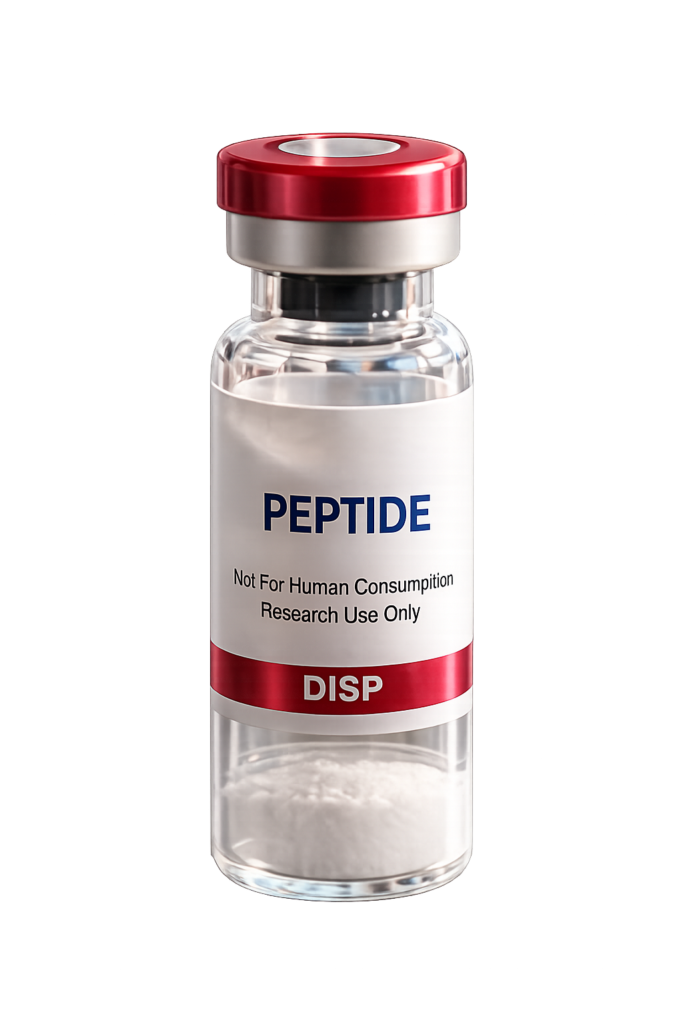
Protocols:
• Dose: 100–300 mcg daily
• Cycle: 4-6 weeks
• Time off: 2-4 weeks
• Always filter after reconstitution
Protocols:
• Dose: 100–300 mcg daily
• Cycle: 4-6 weeks
• Time off: 2-4 weeks
• Always filter after reconstitution
DISP Benefits
The potential DSIP benefits identified across the available research include:
• Sleep normalisation without sedation: Human studies suggest DSIP may improve sleep quality and duration without the daytime sedation, cognitive impairment, or dependence associated with conventional hypnotics.[4]
• Stress modulation: Animal studies indicate potential normalisation of stress-disrupted physiology, including modulation of ACTH and cortisol dynamics.[2]
• Blood-brain barrier crossing: Unlike most peptides, DSIP crosses the BBB via a saturable transport mechanism, enabling central nervous system effects following peripheral exposure.[5]
• Neuroendocrine modulation: Evidence of effects on LH and potentially GH secretion patterns suggests broader endocrine modulatory activity.[6]
• Potential neuroprotection: Preliminary evidence of motor function recovery following stroke and antioxidant properties.[7]
• Anti-seizure properties: DSIP and its tetrapeptide analogue have shown anti-convulsant effects in animal seizure models.[2]
It is essential to note that these DSIP benefits are derived primarily from animal studies and very small human trials conducted decades ago. The evidence confidence for DSIP is limited — considerably weaker than for most peptides featured on this site.
DISP Side Effects
The DSIP side effects profile is difficult to characterise comprehensively due to the limited clinical data available:
• No significant adverse effects reported: In the small human sleep study by Schneider-Helmert and Schoenenberger, no side effects were documented — no daytime sedation, no cognitive impairment, no withdrawal.[4]
• Transient initial arousal: An initial slight arousing effect was observed in the first hour after administration before sleep-promoting effects emerged.[4]
• Extremely limited safety data: With only a handful of human studies involving very small numbers of participants, the full DSIP side effects spectrum is essentially unknown.
• No long-term safety data: No studies have evaluated long-term effects of DSIP exposure in humans.
The absence of reported adverse effects should not be interpreted as evidence of safety. It more likely reflects the extremely limited scope of human studies. Compared to compounds like liraglutide or semaglutide, where thousands of participants in large RCTs have generated comprehensive safety profiles, the DSIP safety dataset is essentially non-existent by modern standards.
What is DISP?
DSIP — delta sleep-inducing peptide — is a naturally occurring nonapeptide with the amino acid sequence Trp-Ala-Gly-Gly-Asp-Ala-Ser-Gly-Glu. First isolated from rabbit cerebral venous blood in 1977 by Schoenenberger and Monnier at the University of Basel, the DSIP peptide was originally identified for its ability to promote delta-wave (slow-wave) activity on EEG recordings during sleep.[1] The name “delta sleep-inducing peptide” has endured, though it is somewhat misleading — subsequent research revealed DSIP to be a broad-spectrum neuromodulator rather than a simple sleep switch.
What is DSIP in practical terms? It is an endogenous neuropeptide that modulates multiple physiological systems simultaneously: sleep architecture, stress response, pain perception, circadian rhythm, and certain endocrine pathways.[1][2] This wide-ranging modulatory profile distinguishes DSIP from targeted receptor agonists like ipamorelin or PT-141, which operate through well-characterised single-receptor mechanisms. DSIP’s mechanism, by contrast, remains incompletely understood — no confirmed receptor has been identified, which is highly unusual for a bioactive peptide with documented physiological effects.
Sometimes referred to as a “delta sleep peptide” or even — incorrectly — as a “deep sleep inducing peptide,” DSIP occupies a unique and somewhat enigmatic position in neuropeptide research. Its evidence base is dominated by studies from the 1980s and 1990s, with relatively little modern investigation. This page examines the available research honestly, including the significant limitations that define the current state of DSIP science.
What does DISP actually do?
• Deep Sleep Promotion: DSIP targets the brainstem and hypothalamus to promote Stage 3 (slow-wave or delta) sleep—the physical restorative phase needed for cell repair, immune support, and memory consolidation. [1, 2]
• Stress & Cortisol Regulation: Research suggests it helps normalize the body's stress response by interacting with pathways that manage cortisol and anxiety. [1, 2]
• Pain Modulation: Some clinical investigations have explored DSIP for its analgesic and anti-inflammatory properties, specifically in breaking the cycle of pain and insomnia. [1]
• Circadian Rhythm: DSIP correlates strongly with the body's diurnal rhythm and may assist in regulating the sleep-wake cycle. [1, 2]
How It Compares
Unlike traditional sleeping pills or benzodiazepines that chemically sedate the brain, DSIP acts as a neuromodulator. It influences neurotransmitter activity (such as GABA and serotonin) to naturally ease the nervous system into rest. It differs significantly from melatonin, which is a hormone strictly responsible for signaling the onset of sleep based on darkness. [1, 2, 3]
Half Life
Delta-sleep-inducing peptide (DSIP) is rapidly broken down by peptidases in the blood. It has a very short plasma half-life of roughly 7 to 8 minutes in humans, and up to 15 minutes in in vitro laboratory conditions.
References
1. Graf MV, Kastin AJ. Delta-sleep-inducing peptide (DSIP): a review. Neurosci Biobehav Rev. 1984;8(1):83-93. PMID: 6145137
2. Graf MV, Kastin AJ. Delta-sleep-inducing peptide (DSIP): an update. Peptides. 1986;7(6):1165-1187. PMID: 3550726
3. Kovalzon VM, Strekalova TV. Delta sleep-inducing peptide (DSIP): a still unresolved riddle. J Neurochem. 2006;97(2):303-309. PMID: 16539679
4. Schneider-Helmert D, Schoenenberger GA. The influence of synthetic DSIP (delta-sleep-inducing-peptide) on disturbed human sleep. Experientia. 1981;37(9):913-917. PMID: 7028502
5. Zlokovic BV, et al. Saturable mechanism for delta sleep-inducing peptide (DSIP) at the blood-brain barrier of the vascularly perfused guinea pig brain. Peptides. 1989;10(2):249-254. PMID: 2547200
6. Sahu A, Kalra SP. Delta sleep-inducing peptide (DSIP) stimulates LH release in steroid-primed ovariectomized rats. Life Sci. 1987;40(12):1201-1206. PMID: 3550343
7. Tukhovskaya EA, et al. Delta Sleep-Inducing Peptide Recovers Motor Function in SD Rats after Focal Stroke. Molecules. 2021;26(17):5173. PMID: 34500605