
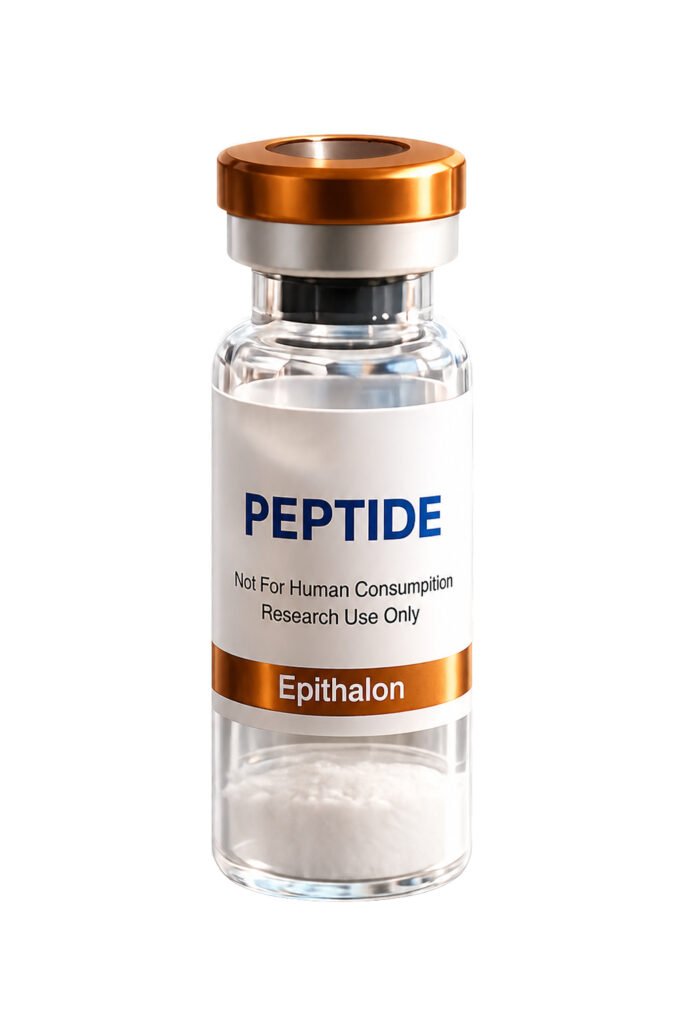
Protocols:
• Dose: 5-10mg daily
• Cycle: 10-20 days
• Time off: 6-8 months
• Always filter after reconstitution
Protocols:
• Dose: 5-10mg daily
• Cycle: 10-20 days
• Time off: 6-8 months
• Always filter after reconstitution
Epithalon Benefits
• Melatonin stimulation: restoration of age-declined melatonin production in ageing animal models via pineal gland activation.
• Antioxidant activity: both direct peptide antioxidant effects and indirect effects through melatonin-mediated pathways.[6]
• Structural simplicity: as a tetrapeptide (four amino acids), epithalon has excellent chemical stability, straightforward synthesis, and predictable molecular behavior.
• Telomerase activation: confirmed in vitro in human cell lines, with telomere elongation demonstrated through both hTERT upregulation and ALT activity.[1]
• Lifespan extension in animal models: consistent findings across multiple mouse strains showing statistically significant increases in mean and maximum lifespan.[3][4]
• Tumour suppression in animal models: reduced spontaneous tumour incidence in SHR mice and suppressed breast adenocarcinoma development in HER-2/neu transgenic mice.[3][4]
Epithalon Side Effects
For epithalon side effects intent, the published preclinical literature reports no significant adverse effects associated with epithalon treatment. Animal studies involving chronic administration over months to years did not document toxicity, organ damage, or behavioural abnormalities in treated groups compared to controls.[3][4]
However, the side effect profile must be interpreted in context. The absence of reported adverse effects reflects the limitations of the available data rather than confirmed safety:
• No human clinical trial safety data: epithalon has not undergone Phase 1, 2, or 3 human safety trials in any Western regulatory framework.
• Single-group research concentration: most published safety observations originate from Khavinson and Anisimov’s research programme. Independent safety evaluation is essentially absent.
• Limited diversity of study populations: animal safety data comes from specific inbred mouse strains under controlled conditions, which may not capture species-specific or population-level adverse effect patterns.
• Theoretical telomerase concerns: telomerase activation is a double-edged mechanism — while it may protect against cellular senescence, uncontrolled telomerase activation is a hallmark of many cancers. The animal data showing tumour suppression rather than promotion is reassuring but not definitive for human contexts.
What is Epithalon?
Epithalon (also written Epitalon or Epithalone) is a synthetic tetrapeptide with the sequence Ala-Glu-Asp-Gly, commonly abbreviated as the AEDG peptide. It was developed by Professor Vladimir Khavinson and colleagues at the St. Petersburg Institute of Bioregulation and Gerontology in Russia as a synthetic analogue of epithalamin — a polypeptide extract derived from the bovine pineal gland. The primary research interest in epithalon centres on its ability to activate telomerase, the enzyme responsible for maintaining telomere length, positioning it as one of the most studied peptides in the field of bioregulatory anti-aging research.
The distinction between epithalon and its precursor epithalamin is important: epithalamin is a crude pineal gland extract containing multiple peptide fractions, while epithalon is the specific four-amino-acid sequence identified as the active component responsible for telomerase activation and melatonin stimulation. This isolation allowed researchers to study a defined molecule rather than a complex biological extract, producing a more reproducible body of preclinical evidence across animal and cell culture models.
Epithalon occupies a unique position in peptide research. It has accumulated a substantial body of Russian-origin preclinical data spanning lifespan extension, tumour suppression, and circadian rhythm modulation in animal models — but until recently lacked independent Western replication. A 2025 in vitro study confirmed telomere elongation in human cell lines, adding credibility to the foundational claims.[1] This page evaluates the evidence as it actually exists: promising but concentrated, with critical gaps in human clinical data.
What does Epithalon actually do?
The core research interest in epithalon revolves around four interconnected mechanisms: telomerase activation, melatonin stimulation, antioxidant activity, and gene expression modulation. In preclinical models, epithalon has demonstrated the ability to upregulate telomerase — the enzyme that adds protective nucleotide sequences to the ends of chromosomes — potentially slowing or partially reversing the telomere shortening associated with cellular ageing. A 2025 study confirmed this effect in human cell lines, showing telomere elongation through both telomerase upregulation and alternative lengthening of telomeres (ALT) activity.[1]
Beyond telomerase, epithalon appears to stimulate melatonin production from the pineal gland, which connects it to circadian rhythm regulation and endogenous antioxidant defence. Animal studies have shown that epithalon treatment normalises melatonin secretion patterns in ageing rodents, where pineal function naturally declines. This dual mechanism — telomere maintenance plus melatonin restoration — forms the theoretical basis for most of the anti-aging research claims associated with the peptide.
An important context point: the majority of this evidence originates from Russian research groups, particularly Khavinson and Anisimov’s laboratories. While the findings are internally consistent across multiple publications, independent replication from Western research institutions has been limited until recently. This does not invalidate the data, but it does mean the evidence base carries a concentration risk that should inform interpretation.
How Epithalon Works
Epithalon’s primary mechanism centres on the activation of human telomerase reverse transcriptase (hTERT), the catalytic subunit of telomerase. The epithalon telomerase activation pathway has been studied across multiple models, and Al-Dulaimi et al. (2025) provided the most recent and methodologically rigorous confirmation: in human cell lines, epithalon treatment produced measurable telomere elongation through two distinct pathways — conventional telomerase upregulation and alternative lengthening of telomeres (ALT) activity.[1] This dual-pathway finding was notable because it suggested epithalon’s effects on telomere maintenance may be more complex than simple enzymatic activation. Research into epithalon telomeres has revealed that the peptide may influence both the rate of telomere shortening and the activation of compensatory lengthening mechanisms — positioning it as a multi-pathway modulator of chromosomal maintenance rather than a single-target enzyme activator.
The pineal gland stimulation pathway operates through a different mechanism. Epithalon appears to act on pinealocytes (pineal gland cells) to increase melatonin biosynthesis, mimicking the regulatory function of the original epithalamin extract. Melatonin itself is both a circadian rhythm regulator and a potent endogenous antioxidant, meaning epithalon’s melatonin-stimulating effects have downstream implications for sleep architecture, oxidative stress management, and immune function. Khavinson’s 2002 foundational review documented the broader framework of peptide bioregulation in ageing, establishing the theoretical basis for how short peptides like epithalon might influence gene expression across multiple tissue types.[2]
The animal evidence base is anchored by Anisimov and colleagues’ long-term studies. In female Swiss-derived SHR mice, epithalon treatment extended lifespan, delayed ageing biomarkers, and reduced spontaneous tumour incidence.[3] In HER-2/neu transgenic mice — a breast cancer model — epithalon decelerated ageing markers and suppressed the development of breast adenocarcinomas.[4] These studies established epithalon as a peptide with consistent preclinical signals across both longevity and oncology-adjacent endpoints.
Half Life
Epithalon’s half-life is estimated at approximately 30 minutes, consistent with the rapid systemic clearance expected of a small tetrapeptide. Formal pharmacokinetic characterisation in the published literature is limited — most studies focus on functional endpoints (telomerase activity, melatonin levels, lifespan) rather than plasma concentration-time profiles.
The short plasma half-life does not necessarily predict the duration of functional effects. Epithalon’s downstream mechanisms — telomerase activation, gene expression modulation, and melatonin pathway stimulation — involve transcriptional and epigenetic changes that may persist well beyond the peptide’s plasma clearance window. This is consistent with the general pharmacology of bioregulatory peptides, where the signalling event is brief but the biological response cascade extends over hours to days.
References
1. Al-Dulaimi S, et al. Epitalon increases telomere length in human cell lines through telomerase upregulation or ALT activity. Biogerontology. 2025;26(5). PMID: 40908429
2. Khavinson VKh. Peptides and Ageing. Neuro Endocrinol Lett. 2002;23 Suppl 3:11-144. PMID: 12374906
3. Anisimov VN, et al. Effect of Epitalon on biomarkers of aging, life span and spontaneous tumor incidence in female Swiss-derived SHR mice. Biogerontology. 2003;4(4):193-202. PMID: 14501183
4. Anisimov VN, et al. Epithalon decelerates aging and suppresses development of breast adenocarcinomas in transgenic her-2/neu mice. Bull Exp Biol Med. 2002;134(2):187-190. PMID: 12459848
5. Araj SK, et al. Overview of Epitalon — Highly Bioactive Pineal Tetrapeptide with Promising Properties. Int J Mol Sci. 2025;26(6):2793. PMID: 40141333
6. Gatta M, et al. The Antioxidant Tetrapeptide Epitalon Enhances Delayed Wound Healing in an in Vitro Model of Diabetic Retinopathy. Stem Cell Rev Rep. 2025. PMID: 40493162
7. Vinogradova IA, et al. Geroprotective effect of ala-glu-asp-gly peptide in male rats exposed to different illumination regimens. Bull Exp Biol Med. 2008;145(4):472-477. PMID: 19110597