
Protocols:
• Dose: 1-2 mg daily
• Cycle: 4-6 weeks
• Time off: 2-4 weeks
• Always filter after reconstitution
Protocols:
• Dose: 1-2 mg daily
• Cycle: 4-6 weeks
• Time off: 2-4 weeks
• Always filter after reconstitution
GHK-Cu Benefits
• Collagen and elastin synthesis promotion: the most reproducible cell-level finding in GHK-Cu research. Documented across multiple independent fibroblast culture studies.[1][2]
• Skin density and elasticity improvements (topical): documented in human trials. The strongest clinical-grade signal GHK-Cu has.[6]
• Hair follicle support signals (topical): biologically plausible via growth factor pathways. In vitro and review-level evidence only at this stage.[6]
• Wound healing acceleration: consistent animal model support across wound, tendon, and ligament contexts. Mechanistic plausibility via fibroblast activation and collagen upregulation.[3][4][7]
• Anti-inflammatory gene modulation: gene array and functional animal data supports downregulation of inflammatory expression patterns. Confirmed in lung fibrosis and liver inflammation models.[5][10]
• Antioxidant support: copper delivery to SOD supports ROS clearance. Documented in vitro and in animal pulmonary models.[5]
• Neuroprotective potential: emerging preclinical evidence in Alzheimer’s and CNS protein aggregation models.[8][9]
Evidence-weighted read: topical skin outcomes have the most defensible evidence base. Injectable benefits remain mechanistically plausible but clinically unconfirmed. Neuroprotection is preclinical but directionally promising.
GHK-Cu Side Effects
For ghk-cu side effects and ghk-cu peptide side effects intent, GHK-Cu has a long history of topical use with a generally favourable tolerance profile. Commonly discussed issues include:
• Skin irritation (topical): contact sensitivity, redness, or irritation, more common at higher concentrations in ghk-cu peptide serum formulations.
• Metallic taste: reported by some subjects following injectable administration in research contexts.
• Injection site reactions: redness, swelling, or discomfort at ghk-cu injection sites. Consistent with most subcutaneous peptide administration.
• Copper toxicity (theoretical): at very high doses, systemic copper accumulation is a theoretical concern. At research-level concentrations this is not a documented practical issue. Copper toxicity requires levels far above typical peptide research use.
• Sparse injectable safety data: the majority of injectable safety context is extrapolated from topical and cell culture research. Independent human injectable safety profiling is largely absent.
For the question is ghk-cu safe: topical GHK-Cu has a well-established tolerability profile across decades of cosmetic use. Injectable safety is less characterised. Trend-based interpretation over weeks is usually safer than reacting to single-day observations.[1][6]
What is GHK-Cu?
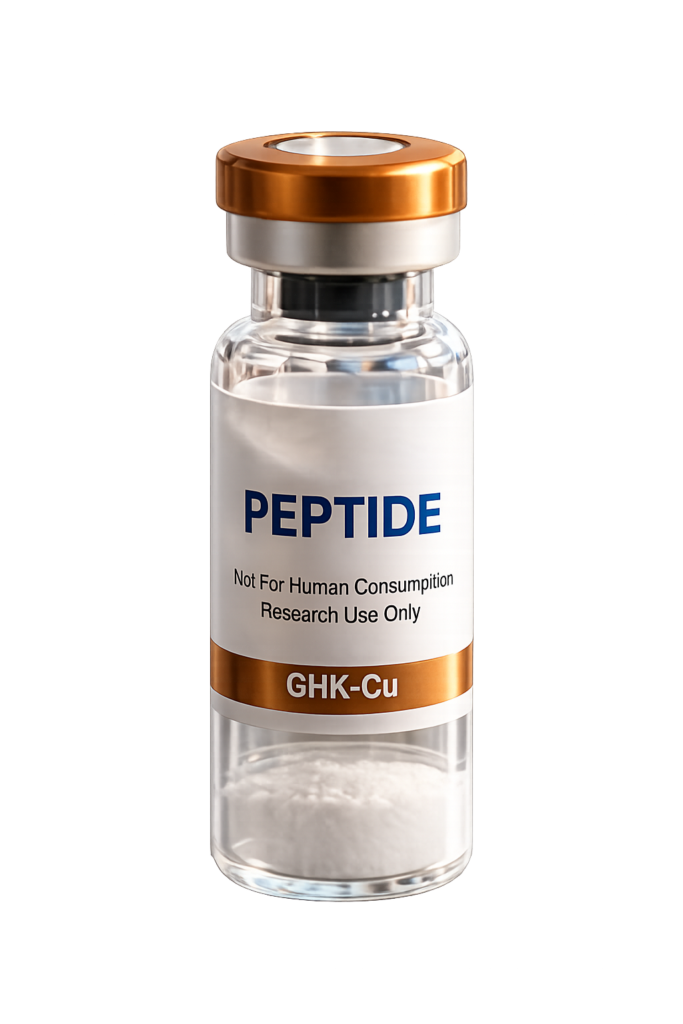
If your query is what is ghk-cu, the practical answer is: GHK-Cu is a naturally occurring copper-binding tripeptide (glycine-histidine-lysine complexed with a copper(II) ion) found in human plasma, saliva, and urine, studied across wound healing, skin biology, neuro protection, and age-related gene expression contexts.[1][2]
In plain language, ghk-cu peptide (also written as copper peptide ghk-cu or simply copper peptide) sits in a different category from most research peptides. It is not discussed in hormonal or anabolic framing. The interest clusters around three areas: tissue repair and wound remodelling, skin quality and collagen density, and broad-spectrum gene expression modulation relevant to longevity research.
The unusual detail: GHK-Cu is endogenous. Plasma levels decline substantially with age, from approximately 200 ng/mL in young adults to around 80 ng/mL by age 60+. That decline has driven sustained research interest, particularly after a 2010 gene array study identified GHK influencing the expression of over 30% of human genes showing significant age-related dysregulation.[1]
This page covers the evidence as it actually exists: strong in vitro and animal data, consistent human topical research for skin endpoints, emerging neuroprotection signals, and an absence of robust injectable human clinical trials. For related context, pair this with the PAL-GHK profile and the PAL-GHK vs GHK-Cu comparison.
What does GHK-Cu actually do?
Most ghk-cu peptide benefits discussion clusters around four practical themes: accelerating tissue repair and wound healing signals, supporting skin quality markers (collagen density, elasticity, fine line depth), modulating gene expression patterns associated with ageing and inflammation, and emerging neuroprotective activity in preclinical models.
Useful signal markers from the literature include:
• Wound closure rate: accelerated epithelialisation and granulation tissue formation in animal wound models, with improved tensile strength in healed tissue.[3][4]
• Collagen and elastin density: fibroblast culture studies consistently show GHK-Cu upregulates collagen types I, III, and IV alongside elastin. This is the most reproducible cell-level finding in the GHK-Cu literature.[1][2]
• Skin thickness and firmness: the most human-relevant area. Topical ghk-cu serum and ghk-cu peptide serum studies show measurable improvements in skin density and fine line reduction over 8 to 12 week periods.[6]
• nAntioxidant enzyme activity: copper delivery to SOD (superoxide dismutase) supports reactive oxygen species clearance, documented in vitro and in animal pulmonary models.[5]
• Anti-inflammatory gene down-regulation: gene array data shows reduction in pro-inflammatory cytokine expression patterns, with functional confirmation in lung fibrosis and liver inflammation models.[5][10]
The critical distinction worth keeping in mind: the skin and topical evidence base is meaningfully stronger than the injectable tissue-repair evidence base. Most wound healing data is animal-derived. Injectable human data does not yet exist at clinical trial standard.
How GHK-Cu Works
GHK-Cu functions primarily as a biological signal molecule and copper transport vehicle. The tripeptide has exceptionally high binding affinity for copper(II) ions, transporting copper into cells and releasing it to copper-dependent enzymes. This triggers downstream cascades across multiple repair and maintenance pathways.[1][2]
Key mechanisms identified in the literature:
• Copper(II) chelation and delivery: GHK transports copper to SOD and lysyl oxidase, activating antioxidant defence and extracellular matrix cross-linking. This copper transport function underlies why copper peptides injections and topical copper peptide formulations are both studied.
• Collagen synthesis signalling: upregulates collagen types I, III, IV and elastin via TGF-β pathway modulation in fibroblast studies.[3]
• MMP regulation: simultaneously stimulates matrix metalloproteinases to clear damaged matrix and promotes new matrix deposition. This is remodelling rather than simple repair.
• VEGF and FGF upregulation: induces angiogenic growth factors, supporting new blood vessel formation in wound environments.[4]
• Broad gene expression modulation: a gene array study identified GHK-Cu influence over genes governing inflammation, tissue remodelling, antioxidant defence, and neurological maintenance. A pleiotropic profile unusual for a tripeptide.[1]
• Neuroprotective signalling: recent research shows GHK-Cu prevents copper- and zinc-induced protein aggregation in CNS tissue, with implications for neurodegenerative disease research.[8]
The interpretation point that matters: mechanism plausibility does not equal guaranteed outcome. Signal quality still depends on the route of administration, the target tissue, and individual context. GHK-Cu injection and ghk-cu peptide injection routes deliver systemic exposure, while topical ghk-cu peptide serum or ghk-cu copper peptide serum targets dermal compartment effects.
Half Life
GHK-Cu’s plasma half-life is estimated at minutes to a few hours systemically. The tripeptide backbone is susceptible to proteolytic degradation, which limits sustained circulating presence after ghk-cu injection. Topical applications follow a different dynamic: skin penetration is concentration-, vehicle-, and formulation-dependent, and the relevant window for topical use is dwell time in the dermal compartment rather than systemic clearance.
This rapid degradation profile is one reason the palmitoylated variant PAL-GHK was developed. Adding a lipid tail increases skin penetration depth and extends local residence time for cosmetic applications.
Practical takeaway: half-life matters for framing, but interpretation quality should come from multi-week trend tracking rather than strict timing assumptions.
References
1. Pickart L, Vasquez-Soltero JM, Margolina A. Regenerative and Protective Actions of the GHK-Cu Peptide in the Light of the New Gene Data. Int J Mol Sci. 2018;19(7):1987. PMID: 29986520.
2. Pickart L, Margolina A. GHK Peptide as a Natural Modulator of Multiple Cellular Pathways in Skin Regeneration. Biomed Res Int. 2015;2015:648108. PMID: 26236730.
3. Maquart FX, et al. In vivo stimulation of connective tissue accumulation by the tripeptide-copper complex glycyl-L-histidyl-L-lysine-Cu2+ in rat experimental wounds. J Clin Invest. 1993;92(5):2368-2376. PMID: 8227353.
4. Rakhmetova KK, et al. Effects of Gly-His-Lys-D-Ala Peptide on Skin Wound Regeneration Processes. Bull Exp Biol Med. 2024;176(3):361-365. PMID: 38345677.
5. Ma WH, et al. Protective effects of GHK-Cu in bleomycin-induced pulmonary fibrosis via anti-oxidative stress and anti-inflammation pathways. Life Sci. 2020;241:117139. PMID: 31809714.
6. Mortazavi SM, et al. Topically applied GHK as an anti-wrinkle peptide: Advantages, problems and prospective. Bioimpacts. 2025;15:30225. PMID: 39963574.
7. Fu SC, et al. Tripeptide-copper complex GHK-Cu (II) transiently improved healing outcome in a rat model of ACL reconstruction. J Orthop Res. 2015;33(7):1024-1033. PMID: 25731775.
8. Min JH, et al. Glycyl-l-histidyl-l-lysine prevents copper- and zinc-induced protein aggregation and central nervous system damage. Metallomics. 2024;16(4):mfae015. PMID: 38599632.
9. Tucker M, et al. Behavioral and neuropathological features of Alzheimer’s disease are attenuated in 5xFAD mice treated with GHK-Cu. Aging Pathobiol Ther. 2024;6(2):65-77. PMID: 40766919.
10. Bian Y, et al. The glycyl-l-histidyl-l-lysine-Cu(2+) tripeptide complex attenuates lung inflammation and fibrosis in bleomycin-induced pulmonary injury. Redox Biol. 2024;73:103195. PMID: 38879894.