
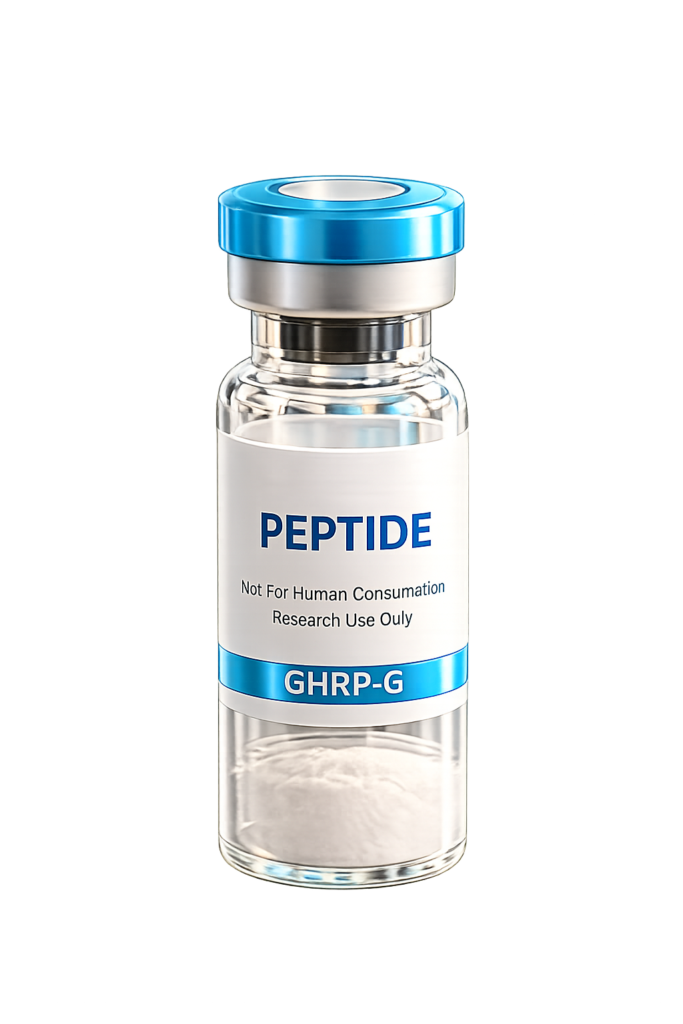
Protocols:
• Dose: 100-300 mcg 3x dailyPEPTIDE
• Cycle: 8-12 weeks
• Time off: 2-4 weeks
• Always filter after reconstitution
Protocols:
• Dose: 100-300 mcg 3x daily
• Cycle: 8-12 weeks
• Time off: 2-4 weeks
• Always filter after reconstitution
GHRP-6 Benefits
• Potent GH secretagogue: One of the strongest acute GH responses among synthetic secretagogues — well-replicated across multiple study designs and populations.[1][2]
• Strong appetite stimulation: Ghrelin-mediated hunger drive can be contextually beneficial for recovery and caloric surplus contexts where energy intake is a limiting factor.
• Emerging cardioprotective data: Preclinical evidence of myocardial protection and ventricular remodelling prevention represents a novel and potentially significant application.[7][8]
• Synergistic with GHRH analogs: Works through a different receptor pathway than sermorelin, CJC-1295, and tesamorelin, enabling dual-pathway GH amplification.
• Extensively characterized pharmacology: Decades of published research establishing dose-response, receptor binding, pharmacokinetics, and safety signals — one of the most studied GHRPs in the literature.[1][5][6]
• Historical research significance: Instrumental in the discovery and characterization of the ghrelin/GHS-R pathway — foundational to the entire GH secretagogue field.[1]
GHRP-6 Side Effects
The GHRP-6 side effects profile (the most commonly reported GHRP 6 side effects are listed below) reflects its lower selectivity compared to newer GH secretagogues:
• Intense appetite increase: The most consistently reported effect — direct ghrelin-pathway activation produces strong hunger drive. Substantially more pronounced than GHRP-2 and largely absent with ipamorelin.[1][4]
• Cortisol elevation: Transient but measurable cortisol and ACTH increases post-administration, confirmed by Oliveira et al. (2003). More pronounced than with GHRP-2 or ipamorelin.[4]
• Prolactin elevation: Small transient increases — clinically relevant primarily at high or chronic exposure levels.
• Water retention: GH-mediated fluid retention, dose-dependent and reversible. Standard across the secretagogue class.
• Transient flushing: Brief warmth or redness shortly after administration, typically self-resolving within minutes.
• WADA prohibited: Classified as a prohibited substance under World Anti-Doping Agency guidelines.
The GHRP-6 side effects trade-off is the central reason the research community has largely moved toward more selective compounds. The GHRP-6 vs ipamorelin comparison illustrates this clearly: comparable GH output but with significantly more hormonal cross-talk from GHRP-6. The GHRP-6 vs GHRP-2 comparison (often searched as GHRP 6 vs GHRP 2) is closer, with GHRP-2 offering modestly better selectivity while still producing appetite and cortisol effects.[1][2][4]
What is GHRP-6?
GHRP-6 (growth hormone releasing peptide 6), also commonly written as GHRP 6, is a synthetic hexapeptide and one of the earliest growth hormone secretagogues (GHS) developed for research. Originally characterised by Cyril Bowers’ group, GHRP-6 peptide (also known as the GHRP 6 peptide) mimics ghrelin’s action on the growth hormone secretagogue receptor (GHS-R1a), triggering potent pulsatile growth hormone release from the anterior pituitary. It belongs to the same receptor-pathway family as GHRP-2 and ipamorelin, but with a distinctly different selectivity profile.
What distinguishes GHRP-6 from more selective GH secretagogues is its broader hormonal footprint. Unlike ipamorelin — described as the first selective GH secretagogue — GHRP-6 also stimulates cortisol, ACTH, and prolactin release, and produces strong appetite stimulation via the ghrelin pathway.[1][4] This lower selectivity positioned GHRP-6 as a foundational research tool rather than a refined therapeutic candidate, but its decades of published data make it one of the most thoroughly characterised compounds in the GHS class.
GHRP-6 holds particular historical significance: it was instrumental in the discovery and characterisation of the ghrelin/GHS-R pathway itself.[1] More recently, emerging cardioprotective research has generated renewed interest in this compound beyond its original GH-releasing applications.[7][8]
What does GHRP-6 actually do?
GHRP 6 is fundamentally a GH-axis activator that works through the ghrelin receptor, producing one of the strongest acute GH responses among synthetic secretagogues. When it binds GHS-R1a on pituitary somatotroph cells, it triggers a rapid, potent pulse of growth hormone release — the defining pharmacological action that made it a cornerstone of early GHS research.[1][2]
Beyond GH release, GHRP-6 produces notable secondary effects that distinguish it from more selective compounds in the same class. The most prominent is strong appetite stimulation — a direct consequence of activating the ghrelin receptor in the hypothalamic arcuate nucleus. This orexigenic effect is substantially more pronounced than with GHRP-2 and largely absent with ipamorelin.[1][4] GHRP-6 also elevates cortisol, ACTH, and prolactin — hormonal cross-talk that cleaner secretagogues avoid.
An unexpected area of renewed interest is GHRP-6’s emerging cardio-protective profile. Preclinical research has demonstrated protective effects against doxorubicin-induced myocardial damage and post-infarct ventricular remodeling, suggesting mechanisms beyond simple GH secretion.[7][8] This represents a potentially significant second chapter for a compound that many had assumed was fully characteriZed.
How GHRP-6 Works
GHRP-6 activates the growth hormone secretagogue receptor type 1a (GHS-R1a) — the same receptor targeted by endogenous ghrelin. Bowers (1998) provided the foundational review of GHRP 6 growth hormone releasing activity and GHRP-6’s mechanism, documenting how it triggers intracellular calcium signaling and phospholipase C activation in anterior pituitary somatotrophs, leading to rapid GH granule exocytosis.[1] Ghigo et al. (1997) further characteriZed the GH-releasing peptide class, establishing the dose-response and receptor-binding profiles that differentiate GHS-R1a agonists from GHRH-pathway compounds like sermorelin and CJC-1295.[2]
The key mechanistic distinction: GHRP-6 works through the ghrelin receptor, not the GHRH receptor. This means it can partially override somatostatin’s inhibitory tone on GH release — a property that GHRH analogs do not share. It also acts at the hypothalamic level, stimulating endogenous GHRH release and creating a dual-level amplification effect on GH secretion. Sinha et al. (2020) reviewed the role of growth hormone secretagogues in body composition management, contextualising GHRP-6 within the broader GHS therapeutic landscape.[3]
Where GHRP-6 diverges from more selective secretagogues is its off-target receptor activity. Oliveira et al. (2003) demonstrated that GHRP-6 stimulates cortisol and ACTH release, confirming broader hypothalamic-pituitary activation beyond the GH axis alone.[4] This contrasts with ipamorelin, which achieves comparable GH release without affecting cortisol, prolactin, or aldosterone. GHRP-2 sits between the two — more selective than GHRP-6 but less so than ipamorelin — creating a clear selectivity spectrum within the GHRP family.
Half Life
GHRP-6 has a plasma half-life of approximately 15–20 minutes — characteristic of the short-acting GHRP class. The compound triggers a rapid, defined GH pulse rather than sustained elevation: peak GH occurs within 15–30 minutes of administration, returning to baseline within 2–3 hours. This pulse-type pharmacokinetic profile preserves the body’s natural pulsatile GH secretory rhythm and somatostatin-mediated feedback.
For comparison across GH-axis peptides: sermorelin has a similar ~10–20 minute half-life, while ipamorelin extends to approximately 2 hours. CJC-1295 without DAC is ~30 minutes, while CJC-1295 with DAC extends to 5–8 days. GHRP-6’s short half-life means its downstream effects — IGF-1 elevation, lipolysis, tissue repair signalling — operate on substantially longer timescales than the compound’s circulating presence.
References
1. Bowers CY. Growth hormone-releasing peptide (GHRP). Cell Mol Life Sci. 1998;54(12):1316-1329. PMID: 9893708
2. Ghigo E, et al. Growth hormone-releasing peptides. Eur J Endocrinol. 1997;136(5):445-460. PMID: 9186261
3. Sinha DK, et al. Beyond the androgen receptor: the role of growth hormone secretagogues in the modern management of body composition in hypogonadal males. Transl Androl Urol. 2020;9(Suppl 2):S149-S159. PMID: 32257855
4. Oliveira JH, et al. GHRP-6 is able to stimulate cortisol and ACTH release in patients with Cushing’s disease. J Endocrinol Invest. 2003;26(3):253-258. PMID: 12809173
5. Camanni F, et al. Growth hormone-releasing peptides and their analogs. Front Neuroendocrinol. 1998;19(1):47-72. PMID: 9465289
6. Micic D, et al. Regulation of growth hormone secretion by the growth hormone releasing hexapeptide (GHRP-6). J Pediatr Endocrinol. 1993;6(3-4):283-289. PMID: 7920995
7. Berlanga-Acosta J, et al. Growth hormone releasing peptide-6 (GHRP-6) prevents doxorubicin-induced myocardial and extra-myocardial damages. Front Pharmacol. 2024;15:1389311. PMID: 38873418
8. Wang L, et al. GHRP-6 Ameliorates Post-Infarct Ventricular Remodeling and Systolic Dysfunction. Pharmaceuticals. 2026;19(3). PMID: 41901314