
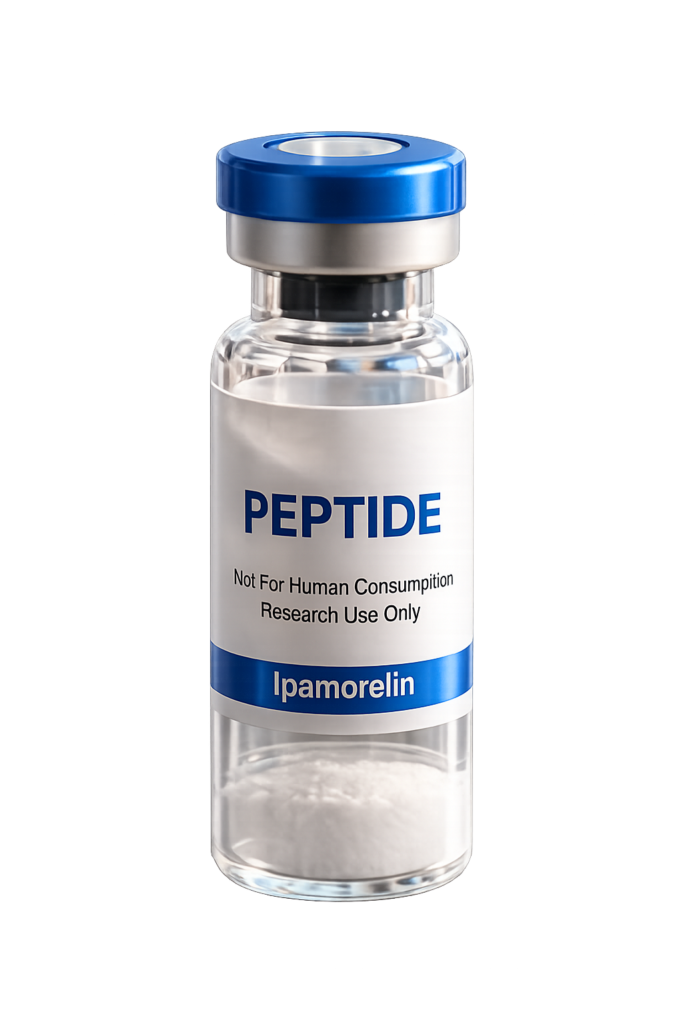
Protocols:
• Dose: 200-300 mcg, 2-3x daily
• Cycle: 8-12 weeks
• Time off: 3-4 weeks
• Always filter after reconstitution
Protocols:
• Dose: 200-300 mcg, 2-3x daily
• Cycle: 8-12 weeks
• Time off: 3-4 weeks
• Always filter after reconstitution
Ipamorelin Benefits
• Recovery and sleep support: amplification of nocturnal GH pulses supports tissue repair, protein synthesis, and recovery quality during sleep.[9]
• Body composition support: GH-mediated improvements in lean mass maintenance and fat mobilisation, without the appetite stimulation that complicates fat loss with other GH secretagogues.[1][8]
• Bone health support: preclinical evidence demonstrates bone growth stimulation, increased bone mineral content, and protection against glucocorticoid-induced bone loss.[4][5][6]
• Minimal cortisol impact: does not elevate cortisol, preserving sleep architecture and avoiding the catabolic, fat-storing effects of cortisol elevation.[1][3]
• Minimal appetite stimulation: unlike GHRP-6 and ghrelin, ipamorelin does not significantly increase appetite — practical for maintaining caloric targets.[1]
• Complementary to GHRH analogs: works through a separate receptor pathway, enabling theoretical synergy with CJC-1295, sermorelin, or tesamorelin.[2][7]
• Many men look to growth-hormone secretagogues, like Ipamorelin, when seeking "hormone optimization," though they do not raise testosterone. They are sometimes used to address overlapping symptoms like low energy, poor sleep, or slow recovery.
• Selective GH release: produces dose-dependent GH elevation without raising cortisol, ACTH, prolactin, or aldosterone — the cleanest GH secretagogue selectivity profile documented.[1]
• Good safety profile: Sigalos & Pastuszak (2018) reviewed GH secretagogues and confirmed acceptable safety profiles as a class.[3]
Ipamorelin Side Effects
For ipamorelin side effects intent, the safety profile benefits from the same selectivity that defines the compound’s advantages:
• Injection site reactions: redness, swelling, or discomfort at the injection site. The most commonly reported adverse effect.[3]
• Head rush or flushing: transient warmth or light-headedness shortly after injection, typically resolving within minutes.[3]
• Headache: occasional, usually mild and transient.[3]
• Water retention: mild fluid retention is possible with sustained GH elevation. Generally less pronounced than with exogenous GH.[3][10]
• Tingling or numbness: paraesthesia can occur with elevated GH/IGF-1 levels, typically mild.[3]What ipamorelin does not typically cause (distinguishing it from other GH secretagogues):
• No significant cortisol elevation — unlike GHRP-2 and GHRP-6[1]
• No significant appetite stimulation — unlike GHRP-6 and ghrelin[1]
• No significant prolactin elevation — unlike GHRP-2[1]
Sigalos & Pastuszak (2018) reviewed GH secretagogues as a class and concluded they have acceptable safety profiles, though long-term surveillance data specifically for ipamorelin remains limited given its investigational status.[3]
What is Ipamorelin?
Ipamorelin is a synthetic growth hormone secretagogue (GHS) — a pentapeptide that stimulates growth hormone release by activating the ghrelin receptor (GHS-R1a) on pituitary somatotroph cells. What distinguishes ipamorelin from other GH secretagogues like GHRP-2 and GHRP-6 is its selectivity: it stimulates GH release without significantly elevating cortisol, ACTH, prolactin, or aldosterone.[1][2]
Raun et al. (1998) described ipamorelin as “the first selective growth hormone secretagogue” in European Journal of Endocrinology, documenting its ability to produce dose-dependent GH release comparable to GHRP-6 while avoiding the broader hormonal perturbations seen with earlier GH secretagogues.[1]
This selectivity profile is ipamorelin’s defining characteristic. While all GH secretagogues activate the ghrelin receptor to stimulate GH release, most also produce varying degrees of appetite stimulation, cortisol elevation, and aldosterone increases. Ipamorelin peptide achieves GH stimulation with minimal off-target hormonal effects, making it the cleanest GH secretagogue in terms of selectivity.[1][2][3]
For context within the GH-axis peptide class, ipamorelin works via a completely different receptor pathway than GHRH analogs like Sermorelin, CJC-1295, and Tesamorelin. While those compounds stimulate GH through the GHRH receptor, ipamorelin acts through the ghrelin/GHS receptor — making them mechanistically complementary rather than competitive.
What does Ipamorelin actually do?
Ipamorelin activates the ghrelin receptor (GHS-R1a) on anterior pituitary somatotroph cells, triggering pulsatile growth hormone release. The practical result is elevated GH and downstream IGF-1 levels achieved through a pathway that complements, rather than replaces, the body’s endogenous GHRH signalling.[1][2]
Key findings from published research:
• Selective GH release (Raun 1998): the foundational study demonstrated that ipamorelin produces dose-dependent GH release comparable to GHRP-6 in both in vitro pituitary cell cultures and in vivo animal models, but without affecting cortisol, ACTH, prolactin, or aldosterone levels — a selectivity advantage over all previously characterised GH secretagogues. Published in European Journal of Endocrinology.[1]
• Mechanistic distinction from GHRH (Ahnfelt-Rønne 2001): confirmed that GH-releasing peptides including ipamorelin act through the ghrelin/GHS receptor pathway rather than the GHRH receptor, establishing the mechanistic basis for dual-pathway GH stimulation when combined with GHRH analogs.[2]
• Bone growth stimulation (Johansen 1999): demonstrated that ipamorelin induces longitudinal bone growth in rats via GH-mediated IGF-1 elevation, supporting the connection between GH secretagogue-driven GH release and tissue-level anabolic effects.[4]
• Bone mineral preservation (Andersen 2001): showed ipamorelin counteracts glucocorticoid-induced decreases in bone formation in adult rats — evidence that GHS-mediated GH elevation can protect against catabolic bone loss.[5]
• Bone mineral content increase (Svensson 2000): ipamorelin and GHRP-6 both increased bone mineral content in adult female rats, demonstrating skeletal benefit from GH secretagogue stimulation.[6]
How Ipamorelin Works
Ipamorelin’s mechanism operates through the ghrelin receptor pathway — pharmacologically distinct from the GHRH receptor pathway used by sermorelin, CJC-1295, and tesamorelin.[1][2]
• GHS-R1a activation: ipamorelin binds the growth hormone secretagogue receptor type 1a (GHS-R1a, also known as the ghrelin receptor) on pituitary somatotroph cells. This triggers intracellular calcium signalling and IP3/DAG pathways, leading to GH granule release.[1][2]
• Selectivity mechanism: unlike GHRP-2 and GHRP-6, ipamorelin does not significantly activate other pituitary hormone pathways. It does not elevate ACTH (which drives cortisol), prolactin, or aldosterone at GH-stimulating doses. This selectivity is attributed to its specific receptor binding profile — strong GHS-R1a affinity without meaningful activation of other receptor subtypes.[1]
• Complementary to GHRH pathway: GH release from somatotrophs is regulated by two opposing signals: GHRH (stimulatory) and somatostatin (inhibitory). GH secretagogues like ipamorelin work through a third, independent pathway (GHS-R1a), amplifying GH release even when GHRH signalling is moderate. This is why ipamorelin CJC-1295 combinations are frequently discussed — they stimulate GH through two separate receptor pathways simultaneously.[2][7]
• Pulsatile release preserved: ipamorelin triggers discrete GH pulses rather than continuous elevation, maintaining the body’s natural secretory rhythm and somatostatin-mediated feedback.[1][3]The dual-pathway concept: when combined with a GHRH analog (CJC-1295 or sermorelin), ipamorelin provides GHS-R1a stimulation while the GHRH analog provides GHRH receptor stimulation. This dual input to the somatotroph cell is theorised to produce a synergistic GH response greater than either pathway alone — though formal head-to-head clinical trials of the combination are limited.[2][7][8]
Half Life
Ipamorelin has an estimated half-life of approximately 2 hours after subcutaneous injection. This places it in the middle range for GH secretagogues — substantially longer than native ghrelin but shorter than modified GHRH analogs.[1][3]
For comparison across GH-axis peptides:
• Native ghrelin: approximately 30 minutes
• Sermorelin (GRF 1-29): approximately 10-20 minutes
• Ipamorelin: approximately 2 hours
• Tesamorelin: approximately 26 minutes
• CJC-1295 (no DAC): approximately 30 minutes
• CJC-1295 (with DAC): approximately 5-8 days
The ~2-hour half-life means ipamorelin produces a defined GH pulse followed by clearance — maintaining the pulsatile pattern that distinguishes secretagogue-mediated GH elevation from continuous exogenous GH. Evening/bedtime administration aligns the GH pulse with the natural nocturnal GH surge.[1][9]
References
1. Raun K, et al. Ipamorelin, the first selective growth hormone secretagogue. Eur J Endocrinol. 1998;139(5):552-561. PMID: 9849822.
2. Ahnfelt-Rønne I, et al. Do growth hormone-releasing peptides act as ghrelin secretagogues? Endocrine. 2001;14(1):133-135. PMID: 11322495.
3. Sigalos JT, Pastuszak AW. The Safety and Efficacy of Growth Hormone Secretagogues. Sex Med Rev. 2018;6(1):45-53. PMID: 28400207.
4. Johansen PB, et al. Ipamorelin, a new growth-hormone-releasing peptide, induces longitudinal bone growth in rats. Growth Horm IGF Res. 1999;9(2):106-113. PMID: 10373343.
5. Andersen NB, et al. The growth hormone secretagogue ipamorelin counteracts glucocorticoid-induced decrease in bone formation of adult rats. Growth Horm IGF Res. 2001;11(5):266-272. PMID: 11735244.
6. Svensson J, et al. The GH secretagogues ipamorelin and GH-releasing peptide-6 increase bone mineral content in adult female rats. J Endocrinol. 2000;165(3):569-577. PMID: 10828840.
7. Merriam GR, et al. Growth hormone-releasing hormone and growth hormone secretagogues in normal aging. Endocrine. 2003;22(1):41-48. PMID: 14610297.
8. Sinha DK, et al. Beyond the androgen receptor: the role of growth hormone secretagogues in the modern management of body composition in hypogonadal males. Transl Androl Urol. 2020;9(Suppl 2):S149-S159. PMID: 32257855.
9. Jessup SK, et al. Blockade of endogenous growth hormone-releasing hormone receptors dissociates nocturnal growth hormone secretion and slow-wave sleep. Eur J Endocrinol. 2004;151(5):561-566. PMID: 15538933.
10. Sattler FR. Growth hormone in the aging male. Best Pract Res Clin Endocrinol Metab. 2013;27(4):541-555. PMID: 24054930.
11. Mayfield CK, et al. Injectable Peptide Therapy: A Primer for Orthopaedic and Sports Medicine Physicians. Am J Sports Med. 2026;54(1):223-229. PMID: 41476424.