
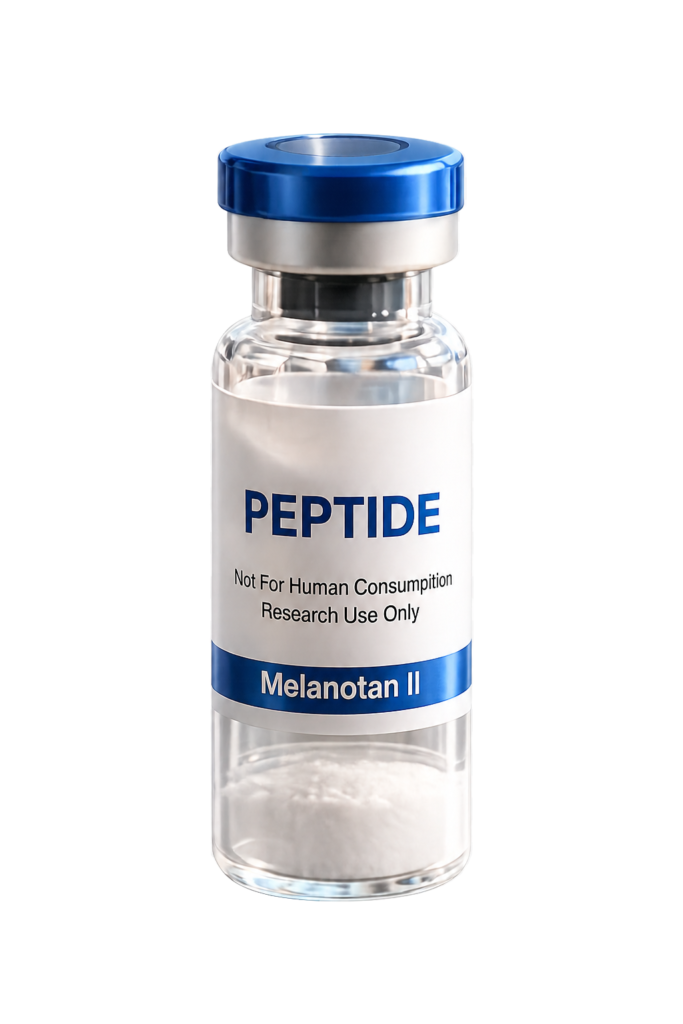
Protocols:
• Dose: 0.25-1 mg every other day
• Cycle: 2-3 months
• Time off: 4-8 weeks between cycles
• Always filter after reconstitution
Protocols:
• Dose: 0.25-1 mg every other day
• Cycle: 2-3 months
• Time off: 4-8 weeks between cycles
• Always filter after reconstitution
Claimed Benefits of Melanotan II
• Darker Pigmentation: Stimulates melanin production to darken skin tone and induce a tan with minimal ultraviolet exposure.
• Appetite Suppression: Interacts with brain receptors to potentially lower hunger and reduce body weight.
• Libido Enhancement: Activates receptors in the central nervous system that can increase sexual arousal and cause spontaneous erections. [1, 2, 3, 4]
Melanotan II Side Effects & Safey Concerns
This section requires particular emphasis because melanotan side effects are both frequent and potentially serious. Unlike many research peptides where safety concerns are largely theoretical due to limited human data, Melanotan II has a documented adverse event profile from clinical trials, case reports, and post-marketing surveillance of unregulated use.
Acute Side Effects (dose-dependent, commonly reported):
• Nausea — the most common adverse event, reported at nearly all dose levels. At 0.025 mg/kg, approximately 13% of subjects experienced severe nausea. This appears to be a direct central effect rather than gastrointestinal.
• Facial flushing — transient vasodilation, typically lasting 30-60 minutes post-administration.
• Fatigue and somnolence — reported at higher doses (Grade II at 0.03 mg/kg.
• Yawning and stretching complex — a distinctive autonomic response that often preceded sexual arousal effects.
• Spontaneous erections — occurring for 1-5 hours post-dose, dose-dependent. While this was the intended therapeutic effect in ED studies, it is an unwanted side effect in tanning contexts and carries risk of priapism.
Dermatological Concerns (significant, potentially dangerous):
• Melanocytic naevi changes — multiple case reports document darkening of existing moles, emergence of new naevi, and dermoscopic changes that can mimic melanoma. Mang et al. (2012) documented sequential dermoscopic changes in a subject using MT-II, finding that naevi changes made it “difficult to differentiate a nevus from a melanoma.”
• Dysplastic naevi — case reports describe the appearance of new dysplastic (atypical) naevi during MT-II use.
• Melanoma concerns — Habbema et al. (2017) reviewed multiple cases where melanomas emerged from existing moles either during or shortly after MT-II use. While causal evidence is lacking, the theoretical concern is that stimulating melanocyte proliferation could accelerate pre-existing malignant or pre-malignant changes.
Cardiovascular and Renal Events:
• Renal infarction — Peters et al. (2020) reported a case of renal infarction attributed to MT-II use, noting possible thrombotic pharmacological effects and direct toxic effects on renal parenchyma.
• Priapism — Dreyer et al. (2019) documented a case of acute priapism requiring emergency cavernosal aspiration and phenylephrine injection. The patient had not recovered erectile function at 4-week follow-up.
• Rhabdomyolysis — documented in association with MT-II use.
Regulatory Warnings:
The UK’s Medicines and Healthcare products Regulatory Agency (MHRA) issued warnings about unlicensed melanotan products in 2008. The Australian Therapeutic Goods Administration (TGA) has repeatedly warned against use. The European Medicines Agency (EMA) has flagged melanotan risks including the danger of contaminated unregulated products. These warnings cite the compound’s unlicensed status, unpredictable purity of internet-sourced products, and the documented adverse event profile as primary concerns.
Any melanotan 2 review that omits these safety concerns is incomplete. The compound carries meaningful risks, particularly with unregulated products of unknown purity, and its development was discontinued specifically because the benefit-risk profile was unfavourable.
What is Melanotan II?
Melanotan II (CAS 121062-08-6, molecular formula C₅₀H₆₉N₁₅O₉, molecular weight 1024.18 g/mol) is a cyclic lactam analog of α-MSH, the endogenous hormone that regulates melanin production in the skin. The mt-2 peptide was synthesised by modifying the core 4-10 amino acid sequence of α-MSH (Ac-Nle⁴-Asp⁵-His⁶-D-Phe⁷-Arg⁸-Trp⁹-Lys¹⁰-NH₂) with a lactam bridge between positions 5 and 10 to create a cyclic structure with enhanced stability and potency.
Unlike the linear α-MSH molecule, which is rapidly degraded by peptidases, the cyclic structure of melanotan 2 confers significantly greater resistance to enzymatic breakdown — though its plasma half-life remains relatively short at approximately one hour. The compound is described as “superpotent” relative to α-MSH in melanotropic activity assays, meaning it stimulates melanocyte activity at substantially lower concentrations.
The critical pharmacological distinction is that melanotan II is non-selective across melanocortin receptor subtypes. It activates MC1R (melanogenesis), MC3R and MC4R (sexual function, appetite, energy homeostasis), and MC5R (exocrine gland function). This broad receptor profile is responsible for both its diverse range of researched effects and its significant side effect burden. It was this non-selectivity that ultimately led to the development of PT-141 (bremelanotide), a derivative engineered for greater MC3R/MC4R selectivity without the melanogenic tanning effects.
How Melanotan II Works
Melanotan 2 exerts its effects through activation of four of the five known melanocortin receptor subtypes. Each receptor mediates distinct physiological processes, which explains the compound’s broad and sometimes problematic activity profile:
MC1R — Melanogenesis. MC1R is expressed primarily on epidermal melanocytes. When activated by melanotan II, it triggers a cAMP-dependent signalling cascade that upregulates tyrosinase activity and shifts melanin production from the lighter pheomelanin toward the darker eumelanin. This is the mechanism underlying the compound’s tanning effect — increased eumelanin synthesis produces visible skin darkening, often described in research subjects after only a few administrations.[1][6] This mechanism is distinct from UV-induced tanning in that it can occur independently of ultraviolet light exposure, though it works synergistically with UV.
MC3R and MC4R — Sexual Function and Appetite. These centrally-expressed receptors in the hypothalamus mediate the compound’s effects on sexual arousal and appetite. MC4R activation in the paraventricular nucleus has been shown to initiate erectile responses in male subjects and increase sexual desire in both sexes.[2][3] The same MC4R pathway is involved in central appetite regulation — activation of hypothalamic MC4R suppresses food intake, contributing to the anorexigenic effects observed during melanotan 2 tanning research.[5] MC3R contributes to both sexual arousal and energy homeostasis, though its specific role remains less well characterised.
MC5R — Exocrine Function. MC5R is expressed in exocrine glands (sebaceous, lacrimal, preputial). Its activation by MT-II may influence sebum production and exocrine secretion, though this pathway has received the least research attention in the context of melanotan II specifically.
The non-selective activation of all these receptors simultaneously is the core issue with melanotan 2 as a therapeutic candidate. The desired melanogenic effect via MC1R cannot be separated from the centrally-mediated sexual, appetite, and autonomic effects via MC3R/MC4R, or the nausea and fatigue that appear to be dose-dependent class effects.
Half Life
Melanotan II has a relatively short plasma half-life of approximately 1 hour following subcutaneous administration. This is substantially shorter than many other research peptides — for comparison, PT-141 has a half-life of approximately 2.5 hours, and GLP-1 agonists like semaglutide have half-lives measured in days.
Despite this short half-life, the melanogenic effects of MT-II persist well beyond the plasma clearance period. In the Dorr et al. (1996) Phase I trial, increased pigmentation was measurable one week after dosing ended, suggesting that the downstream melanocyte effects (eumelanin synthesis, melanin deposition in keratinocytes) operate on a much longer timescale than the peptide’s presence in circulation.
This is pharmacodynamically consistent — melanin, once synthesised and deposited, persists until the melanin-containing keratinocytes are shed through normal epidermal turnover.The compound is administered primarily via subcutaneous injection in research settings. Intranasal formulations (melanotan nasal spray) have been investigated and show bioavailability, though with greater inter-subject variability and lower peak plasma levels compared to injection. Oral bioavailability is negligible due to peptide degradation in the gastrointestinal tract.
References
1. Dorr RT, Lines R, Levine N, et al. Evaluation of melanotan-II, a superpotent cyclic melanotropic peptide in a pilot phase-I clinical study. Life Sci. 1996;58(20):1777-1784. PubMed
2. Hadley ME. Discovery that a melanocortin regulates sexual functions in male and female humans. Peptides. 2005;26(10):1687-1689. PubMed
3. Wessells H, Fuciarelli K, Hansen J, et al. Synthetic melanotropic peptide initiates erections in men with psychogenic erectile dysfunction: double-blind, placebo controlled crossover study. J Urol. 1998;160(2):389-393. PubMed
4. Wessells H, Gralnek D, Dorr R, Hruby VJ, Hadley ME, Levine N. Effect of an alpha-melanocyte stimulating hormone analog on penile erection and sexual desire in men with organic erectile dysfunction. Urology. 2000;56(4):641-646. PubMed
5. Wessells H, Levine N, Hadley ME, Dorr R, Hruby V. Melanocortin receptor agonists, penile erection, and sexual motivation: human studies with Melanotan II. Int J Impot Res. 2000;12 Suppl 4:S74-S79. PubMed
6. Habbema L, Halk AB, Neumann M, Bergman W. Risks of unregulated use of alpha-melanocyte-stimulating hormone analogues: a review. Int J Dermatol. 2017;56(10):975-980. PubMed
7. Mang R, Krahl D, Assmann T. Dermoscopic changes in melanocytic nevi during use of melanotan II. Hautarzt. 2012;63(11):880-884. PubMed
8. Langan EA, Nie Z, Rhodes LE. Melanotropic peptides: more than just ‘Barbie drugs’ and ‘sun-tan jabs’? Br J Dermatol. 2010;163(3):451-455. PubMed
9. Peters B, Hadimeri J, Gärskog O, Tiselius C, Ekberg J. Melanotan II: a possible cause of renal infarction: review of the literature and case report. CEN Case Rep. 2020;9(2):159-161. PubMed
10. Fani L, Bak S, Delhanty P, van Rossum EFC, van den Akker ELT. The melanocortin-4 receptor as target for obesity treatment: a systematic review of emerging pharmacological therapeutic options. Int J Obes (Lond). 2014;38(2):163-169. PubMed