
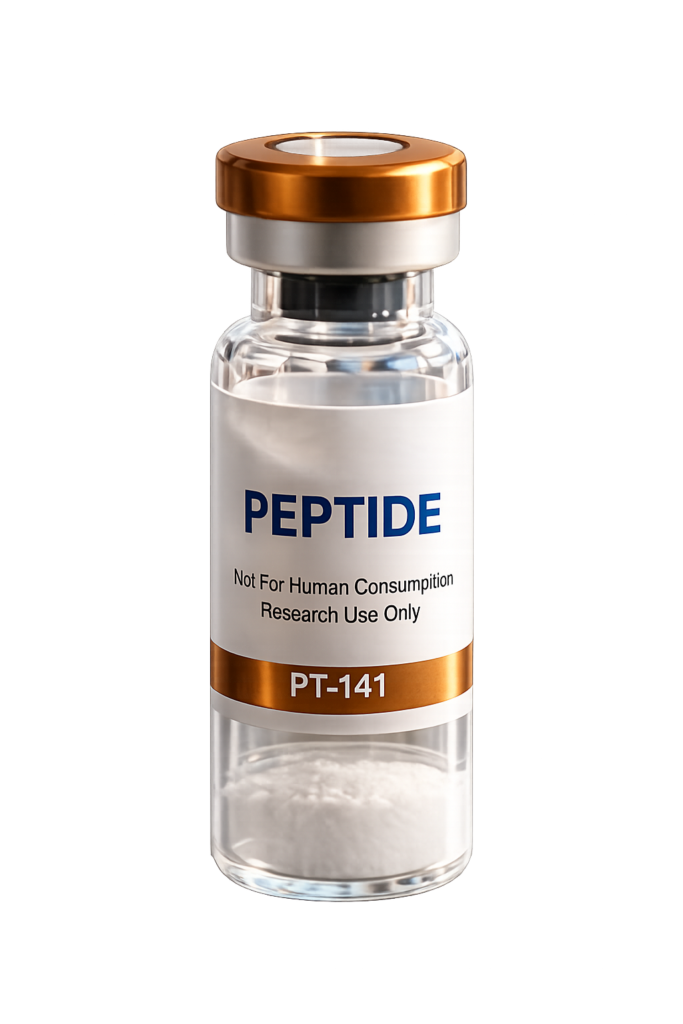
Protocols:
• Dose: 1-2 mg as needed
• Cycle: Max 8x/month
• Always filter after reconstitution
Protocols:
• Dose: 1-2 mg as needed
• Cycle: Max 8x/month
• Always filter after reconstitution
PT-141 Benefits
• Increases Sexual Desire: Stimulates neural pathways in the hypothalamus to help restore natural libido and motivation for intimacy. [1, 2]
• Improves Arousal Response: Enhances overall physical sensitivity and responsiveness, which can ease performance anxiety and boost intimacy satisfaction. [1, 2, 3]
• Targets the Brain, Not Just Circulation: Bypasses the blood-flow limitations of standard phosphodiesterase-5 (PDE5) inhibitors like Viagra or Cialis by addressing the psychological and neurological spark of arousal. [1, 2]
• FDA-Approved Indication: Formulated and approved under the brand name Vyleesi to treat hypoactive sexual desire disorder (HSDD) in premenopausal women. [1, 2]
• Alternative for ED Non-Responders: Frequently utilized off-label or in clinical research settings to assist men who do not achieve adequate results from conventional blood-flow medications. [1, 2]
• Non-hormonal mechanism — does not modulate estrogen, progesterone, or testosterone levels directly, offering a mechanistically distinct profile from hormonal interventions.
• On-demand pharmacokinetic profile — rapid onset (~1 hour to peak plasma) with moderate duration, investigated as an as-needed compound rather than requiring daily administration.[3]
• Phase 3 RCT evidence — efficacy demonstrated across two large randomised controlled trials (RECONNECT) with statistically significant improvements in desire and distress endpoints.[2]
• Sustained efficacy — long-term open-label extension data showed maintained response without evidence of tachyphylaxis over 18 months.[3]
• Mechanistic distinction from PDE5 inhibitors — entirely different target pathway from sildenafil/tadalafil, relevant for contexts where vascular interventions are inappropriate or insufficient.
PT-141 Side Effects
PT 141 side effects are well-characterised from Phase 3 clinical trials and the open-label extension study. The profile is tiered below by evidence confidence:
Well-documented (Phase 3 RCT data):
• Nausea — the most commonly reported adverse event, observed in approximately 40% of participants in clinical trials. Most episodes were mild-to-moderate and decreased with repeated administration.[2][3]
• Flushing — reported in approximately 20% of trial participants, consistent with melanocortin receptor activation and vasomotor effects.[2]
• Injection site reactions — localised erythema, pain, or induration at the administration site, typical of subcutaneous peptide research.[3]
• Headache — reported in a subset of participants across both RECONNECT trials.[2]
Observed in clinical monitoring:
• Transient blood pressure changes — ambulatory blood pressure monitoring studies (White 2017) documented small, transient increases in systolic blood pressure following administration. These changes were generally not clinically significant in normotensive participants but represent a monitoring consideration.[5]
Monitoring considerations:
• Skin hyperpigmentation — rare but reported, consistent with melanocortin receptor activation. Unlike Melanotan II, PT-141 was engineered to minimise melanogenic activity, but low-level MC1R interaction cannot be fully excluded.[4]
What is PT-141?
If your query is what is pt-141, the practical answer is: PT-141 (bremelanotide), marketed under the brand name Vyleesi®, is a synthetic cyclic heptapeptide and melanocortin receptor agonist investigated primarily in libido and sexual function research contexts. In June 2019, it became the first and only FDA-approved on-demand melanocortin agonist for hypoactive sexual desire disorder (HSDD) in premenopausal women — a mechanism class entirely distinct from peripheral vasodilators like PDE5 inhibitors.
PT-141 peptide (also written as PT 141 peptide, PT 141, pt-141 peptide, or bremelanotide peptide) was derived from Melanotan II (MT-II), a synthetic analog of α-melanocyte-stimulating hormone (α-MSH). However, the two compounds are structurally and functionally distinct: PT-141 is the active metabolite of MT-II, engineered without melanogenic (tanning) activity. Where MT-II activates all five melanocortin receptor subtypes — producing skin pigmentation alongside other effects — bremelanotide selectively targets MC3R and MC4R in the hypothalamus, modulating neural pathways involved in sexual arousal and desire without skin-darkening effects.
This page covers the evidence as it actually exists: FDA-approved clinical trial data for premenopausal HSDD, the melanocortin mechanism of action, and the practical limits of current research. For broader context, see the Libido & Sexual Function and Testosterone / Hormonal Support goal pages.
What does PT-141 actually do?
Most bremelanotide peptide discussion centres on one practical distinction: PT-141 operates centrally — in the brain — rather than peripherally in vascular tissue. This is fundamentally different from how PDE5 inhibitors (sildenafil, tadalafil) work. Those compounds increase blood flow to peripheral tissues. PT-141 instead activates melanocortin receptors in the hypothalamus, modulating the neural circuitry that governs sexual desire and arousal at its origin point.[1]
In practical terms, this means bremelanotide targets the desire component of sexual function — the central nervous system pathways that initiate arousal — rather than the mechanical component of blood flow and tissue response. This distinction is why PT-141 was investigated specifically for hypoactive sexual desire disorder (HSDD), a condition characterised by persistently low sexual desire causing distress, rather than for erectile dysfunction or arousal disorders with purely vascular origins.[2][4]
The melanocortin pathway itself is one of the brain’s core regulatory systems, involved in appetite, energy balance, inflammation, and neuroendocrine signalling. PT-141’s specificity for the MC3R and MC4R subtypes within this system is what gives it a relatively targeted sexual function profile compared to broader melanocortin agonists like Melanotan II, which activates all five receptor subtypes.[1]
How PT-141 Works
To understand PT 141 how does it work requires examining the molecular detail. Bremelanotide’s mechanism of action centres on activation of melanocortin-3 (MC3R) and melanocortin-4 (MC4R) receptors in the medial preoptic area and paraventricular nucleus of the hypothalamus. These regions are critical integration hubs for sexual motivation, connecting sensory input, hormonal status, and emotional context into behavioural output. When PT-141 binds these receptors, it initiates downstream signalling cascades that modulate dopaminergic and oxytocinergic pathways — two neurotransmitter systems directly implicated in sexual desire, reward, and pair-bonding behaviour.[1]
The α-MSH pathway provides the natural context. Alpha-melanocyte-stimulating hormone is an endogenous neuropeptide that activates melanocortin receptors as part of normal neuroendocrine signalling. PT-141, as a synthetic analog of α-MSH (via its parent compound MT-II), mimics this natural activation with greater receptor selectivity and metabolic stability. The result observed in clinical research is enhanced central arousal signalling without the peripheral vascular changes that characterise PDE5 inhibitor activity.[1][7]
Importantly, this central mechanism means PT-141’s observed effects are not dependent on peripheral blood flow enhancement. In the RECONNECT Phase 3 trials, the primary endpoint measured was the change in the Female Sexual Function Index (FSFI) desire domain score and the Female Sexual Distress Scale (FSDS-DAO) — measures of subjective desire and associated distress, not physiological arousal metrics.[2] This aligns with the mechanistic prediction: a compound acting on hypothalamic desire circuits should improve desire-related endpoints rather than vascular arousal markers.
Half Life
PT-141 has a plasma half-life of approximately 2.5 hours, placing it in the on-demand pharmacokinetic category rather than the sustained-release or depot profiles seen with compounds like CJC-1295 with DAC or semaglutide. Peak plasma concentration is reached approximately 1 hour after subcutaneous administration, with the onset of observed effects typically reported within 45 minutes to 1 hour in clinical trial protocols.[4][7]
This pharmacokinetic profile informed the clinical trial design: in the RECONNECT programme, bremelanotide was investigated as an as-needed compound administered approximately 45 minutes before anticipated sexual activity, with a recommended minimum interval of 24 hours between administrations. The relatively rapid clearance supports the on-demand framing — effects are temporally bounded rather than continuous, distinguishing PT-141 from daily-administration compounds like flibanserin.[2][3]
For researchers evaluating peptide pharmacokinetics, the ~2.5-hour half-life positions bremelanotide between very short-acting peptides (e.g., natural GnRH, ~2-4 minutes) and longer-acting modified peptides. The cyclic heptapeptide structure provides sufficient metabolic stability for clinically meaningful duration without requiring half-life extension modifications like PEGylation or albumin binding.
References
1. Pfaus JG, et al. The neurobiology of bremelanotide for the treatment of hypoactive sexual desire disorder in premenopausal women. CNS Spectr. 2022;27(3):281-295. PMID: 33455598
2. Kingsberg SA, et al. Bremelanotide for the Treatment of Hypoactive Sexual Desire Disorder: Two Randomized Phase 3 Trials. Obstet Gynecol. 2019;134(5):899-908. PMID: 31599840
3. Simon JA, et al. Long-Term Safety and Efficacy of Bremelanotide for Hypoactive Sexual Desire Disorder. Obstet Gynecol. 2019;134(5):909-917. PMID: 31599847
4. Dhillon S, Keam SJ. Bremelanotide: First Approval. Drugs. 2019;79(14):1599-1606. PMID: 31429064
5. White WB, et al. Usefulness of ambulatory blood pressure monitoring to assess the melanocortin receptor agonist bremelanotide. J Hypertens. 2017;35(4):761-767. PMID: 27977473
6. Diamond LE, et al. An effect on the subjective sexual response in premenopausal women with sexual arousal disorder by bremelanotide (PT-141). J Sex Med. 2006;3(4):628-638. PMID: 16839319
7. Mayer D, Lynch SE. Bremelanotide: New Drug Approved for Treating Hypoactive Sexual Desire Disorder. Ann Pharmacother. 2020;54(7):684-690. PMID: 31893927