
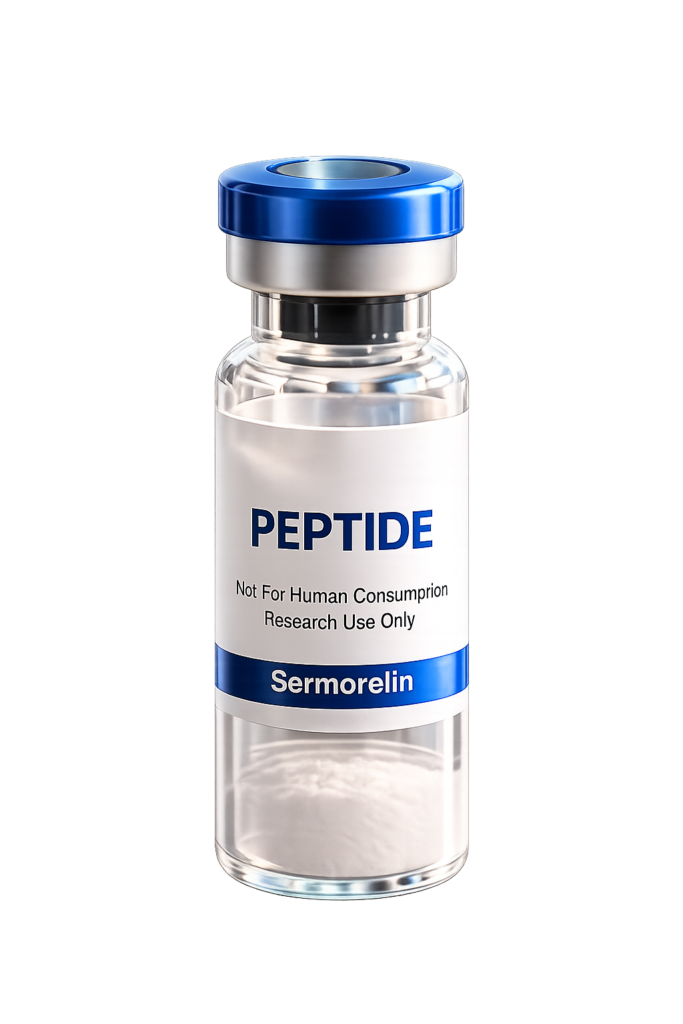
Protocols:
• Dose: 200-500 mcg once nightly 5x/week
• Cycle: 3-6 months
• Time off: 1-2 months
• Always filter after reconstitution
Protocols:
• Dose: 200-500 mcg once nightly 5x/week
• Cycle: 3-6 months
• Time off: 1-2 months
• Always filter after reconstitution
Sermorelin Benefits
• Lean body mass improvement: significant increases documented in elderly subjects over 16 weeks, alongside body fat reductions.[1]
• Immune function enhancement: improved NK cell activity and lymphocyte function in aging populations, addressing immune senescence.[5]
• Recovery and sleep support: amplification of nocturnal GH pulses supports tissue repair and recovery quality during sleep.[6]
• Many men look to growth-hormone secretagogues, like Sermorelin, when seeking "hormone optimization," though they do not raise testosterone. They are sometimes used to address overlapping symptoms like low energy, poor sleep, or slow recovery.
• Longest clinical safety history: as the first FDA-approved GHRH analog (Geref®, 1997), sermorelin has the longest clinical track record of any compound in its class.[2][3]
• Physiological GH axis restoration: stimulates natural pulsatile GH secretion via the GHRH receptor, maintaining hypothalamic-pituitary feedback — the most natural approach to GH-axis support available.[1][2][4]
• Well-tolerated safety profile: Sigalos & Pastuszak (2018) reviewed GH secretagogues as a class and concluded they have acceptable safety profiles, with sermorelin’s established history providing additional confidence.[8]
• Somatopause mitigation: addresses age-related GH decline through physiological mechanisms rather than pharmacological replacement.[1][4][9]
Evidence-weighted read: multi-system aging benefits (lean mass, immune function, IGF-1) are supported by controlled human studies. Sleep and recovery benefits are mechanistically grounded and practically reported but less formally studied. Benefits of sermorelin are strongest when fundamentals are stable and outcomes are tracked across weeks.[1][5]
What is Sermorelin?
Sermorelin (also known as sermorelin acetate or GRF 1-29) is the first 29 amino acids of human growth hormone-releasing hormone (GHRH). It is a historically significant compound — the first GHRH analog to receive FDA approval (as Geref® for paediatric GH deficiency diagnosis and treatment), giving it the longest clinical track record of any GHRH-pathway peptide.
[1][2][3]Sermorelin peptide stimulates the anterior pituitary to release growth hormone in a pulsatile pattern that preserves the body’s natural GH secretory rhythm. Unlike exogenous GH, sermorelin works through the GHRH receptor rather than bypassing pituitary regulation, which is considered physiologically advantageous for maintaining feedback integrity.
[1][4]Khorram et al. (1997) conducted one of the most important sermorelin aging studies, demonstrating that long-term administration of GRF(1-29)-NH₂ in age-advanced men and women produced sustained increases in IGF-1, improvements in lean body mass, and enhanced immune function markers — without the adverse effects associated with exogenous GH.[1][5]
For context across the GH-axis peptide class, this page pairs naturally with CJC-1295 (a modified, longer-acting GHRH analog), Tesamorelin (an FDA-approved GHRH analog with stronger body composition data), and Ipamorelin (a GH secretagogue that works via the ghrelin receptor rather than GHRH).
What does Sermorelin actually do?
Sermorelin stimulates the anterior pituitary to release growth hormone in pulses that mirror the body’s natural secretory rhythm. The practical result is elevated GH and IGF-1 levels achieved through physiological pathways rather than pharmacological override.[1][2][4]
Key findings from human studies:
• Long-term GH axis restoration in aging: Khorram et al. (1997) administered GRF(1-29)-NH₂ nightly for 16 weeks to men and women aged 55-71. Results: significant increases in 24-hour GH secretion, elevated IGF-1 levels, increased lean body mass, and reduced body fat — with improvements sustained throughout the treatment period.[1]
• Immune function enhancement: in a companion study, Khorram et al. (1997) demonstrated that the same GRF(1-29) protocol increased natural killer cell number, improved lymphocyte proliferation, and enhanced immune responsiveness in elderly subjects.[5]
• Paediatric growth stimulation: Brain et al. (1990) showed that continuous subcutaneous GHRH(1-29)-NH₂ promoted growth over 12 months in short, slowly growing children — the clinical basis for the original FDA approval.[3]
• Sleep-GH relationship: Jessup et al. (2004) demonstrated that endogenous GHRH receptor activation is specifically linked to nocturnal GH secretion, supporting the mechanistic basis for sermorelin’s reported sleep quality effects.[6]
• Body composition in hypogonadal men: Sinha et al. (2020) reviewed GH secretagogues as body composition management tools, noting GHRH analogs like sermorelin as adjuncts for lean mass maintenance and fat reduction in clinical contexts.[7]
How Sermorelin Works
Sermorelin is the native human GHRH(1-29) sequence — the biologically active fragment of the full 44-amino-acid GHRH molecule. Research established that the first 29 amino acids retain full biological activity at the GHRH receptor, making the remaining 15 residues dispensable.[2][4]
The mechanism operates through a well-characterised pathway:
• GHRH receptor binding: sermorelin binds the GHRH receptor on somatotroph cells in the anterior pituitary, triggering intracellular cAMP signalling that stimulates both GH synthesis and release.[2][4]
• Pulsatile secretion preservation: unlike exogenous GH, sermorelin works through the hypothalamic-pituitary axis, meaning somatostatin-mediated feedback remains intact. GH is released in natural pulses rather than continuous elevation.[1][4]
• IGF-1 cascade: elevated GH drives hepatic IGF-1 production, which mediates downstream effects on body composition, tissue repair, immune function, and metabolic regulation.[1][5]
• Nocturnal GH amplification: sermorelin administration (typically evening/bedtime) amplifies the largest natural GH pulse, which occurs during slow-wave sleep. Jessup et al. (2004) confirmed the specific link between GHRH receptor activity and nocturnal GH secretion.[6]
The key pharmacological limitation: sermorelin uses the unmodified native GHRH(1-29) sequence, which is rapidly degraded by DPP-IV enzymes. This gives it a very short half-life (~10-20 minutes), requiring precise timing and more frequent administration compared to modified GHRH analogs like CJC-1295 or Tesamorelin.[2][8]
Half Life
Oxytocin has an incredibly short plasma half-life of roughly 3 to 5 minutes. Because it is a peptide hormone, it is rapidly broken down by enzymes in the liver and kidneys. This quick clearance allows the body to turn off its bonding and physiological effects almost as quickly as they are turned on. [1, 2, 3]
Because this half-life is so short, continuous intravenous infusions (often marketed under the brand name Pitocin) are required if the hormone is being used medically to induce labor or manage postpartum bleeding. Uterine responses from an IV dose subside within 1 hour. [1, 2, 3, 4]
Sermorelin Side Effects
For sermorelin side effects intent, the safety profile benefits from sermorelin’s extensive clinical history:
• Injection site reactions: redness, swelling, or discomfort at injection sites. The most commonly reported adverse effect across clinical use.[2][8]
• Flushing: transient warmth or facial flushing after injection, typically resolving within minutes.[2]
• Headache: reported in some subjects, usually mild and transient.[2]
• Dizziness: occasionally reported, generally mild.[2]
• Difficulty swallowing or taste changes: uncommon but documented in prescribing information.[2]
• Antibody formation: long-term use can trigger anti-GHRH antibodies that may reduce efficacy over time. This is a known consideration with peptide therapies and may require periodic evaluation.[2][3]
The Khorram aging studies reported the GRF(1-29) protocol was well tolerated over 16 weeks in elderly subjects, with no serious adverse events.[1][5] Sigalos & Pastuszak’s 2018 safety review confirmed that GH secretagogues as a class have acceptable safety profiles, while noting the need for longer-term surveillance in general use.[8]
Compared to exogenous GH, sermorelin’s side effect profile is generally milder because it works through physiological pathways: fluid retention, joint pain, and insulin resistance — common with exogenous GH — are less frequent with GHRH-pathway stimulation that preserves feedback regulation.[4][8][9]
References
1. Khorram O, et al. Endocrine and metabolic effects of long-term administration of [Nle27]growth hormone-releasing hormone-(1-29)-NH₂ in age-advanced men and women. J Clin Endocrinol Metab. 1997;82(5):1472-1479. PMID: 9141536.
2. Memdouh S, et al. Advances in the detection of growth hormone releasing hormone synthetic analogs. Drug Test Anal. 2021;14(1):76-86. PMID: 34665524.
3. Brain CE, et al. Continuous subcutaneous GHRH(1-29)-NH₂ promotes growth over 1 year in short, slowly growing children. Clin Endocrinol (Oxf). 1990;32(3):375-386. PMID: 2140733.
4. Merriam GR, et al. Growth hormone-releasing hormone and growth hormone secretagogues in normal aging. Endocrine. 2003;22(1):41-48. PMID: 14610297.
5. Khorram O, et al. Effects of [norleucine27]growth hormone-releasing hormone (GHRH) (1-29)-NH₂ administration on the immune system of aging men and women. J Clin Endocrinol Metab. 1997;82(11):3590-3596. PMID: 9360512.
6. Jessup SK, et al. Blockade of endogenous growth hormone-releasing hormone receptors dissociates nocturnal growth hormone secretion and slow-wave sleep. Eur J Endocrinol. 2004;151(5):561-566. PMID: 15538933.
7. Sinha DK, et al. Beyond the androgen receptor: the role of growth hormone secretagogues in the modern management of body composition in hypogonadal males. Transl Androl Urol. 2020;9(Suppl 2):S149-S159. PMID: 32257855.
8. Sigalos JT, Pastuszak AW. The Safety and Efficacy of Growth Hormone Secretagogues. Sex Med Rev. 2018;6(1):45-53. PMID: 28400207.
9. Sattler FR. Growth hormone in the aging male. Best Pract Res Clin Endocrinol Metab. 2013;27(4):541-555. PMID: 24054930.
10. Mayfield CK, et al. Injectable Peptide Therapy: A Primer for Orthopaedic and Sports Medicine Physicians. Am J Sports Med. 2026;54(1):223-229. PMID: 41476424.
11. Baker LD, et al. Effects of growth hormone-releasing hormone on cognitive function in adults with mild cognitive impairment and healthy older adults. Arch Neurol. 2012;69(11):1420-1429. PMID: 22869065.